About 351 minutes
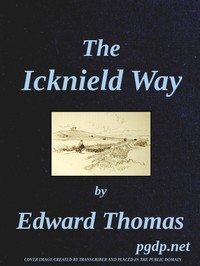
The Icknield Way — A Reader’s Guide
Travel Narratives
80,647 recorded words. 46 minutes difference from this book's estimate.
View Gutenberg source #57097
The catalog record for In Pursuit of Spring — Story, Setting & Ideas provides practical reading context through 70,136 words, 5 hr 5 min estimated reading time, and 15 detected text sections.
The text analysis averages about 24.3 words per sentence, while the detected sections provide another way to judge how the source is divided.
Project Gutenberg metadata also associates the work with “Great Britain -- Description and travel,” connecting these edition facts with the source record’s subject description.
Explore this collection
These alternatives are selected using recorded categories and estimated reading time.
About 351 minutes
Travel Narratives
80,647 recorded words. 46 minutes difference from this book's estimate.
View Gutenberg source #57097About 218 minutes
Travel Narratives
49,997 recorded words. 87 minutes difference from this book's estimate.
View Gutenberg source #4068About 183 minutes
Travel Narratives
41,986 recorded words. 122 minutes difference from this book's estimate.
View Gutenberg source #57347Search stored excerpts and compare books → Choose by your preferences →
Choices use stored catalog measurements. Estimates vary with reading speed. A shared category is a catalog label, not a claim that two books have the same argument or literary quality.
Search reads excerpt text stored with this catalog and links to its associated Gutenberg record. The connection is stored in the site database; this tool does not recheck that every excerpt is word-for-word identical to that external record. Excerpt search does not cover every chapter and does not verify historical publication dates.
Catalog snapshot checked: 2026-09-25. Coverage: 97 public books, 97 available source excerpts.
Calculated from edition completeness, EPUB availability, text structure and catalogue metadata. Not a user rating.
Total of 100 points, scaled to a 2.5-5.0 range. Editions with an empty description or a missing EPUB file are not scored.
Public-domain source text
The source text is kept in the dedicated reader, separate from this catalogue record and its commentary.
Edward Thomas's In Pursuit of Spring opens with a declaration of purpose: 'This is the record of a journey from London to the Quantock Hills.' The journey, undertaken on a bicycle during a March Easter, is framed as a deliberate search for the season's advance. Thomas immediately establishes a measured, observational voice, noting that he began 'to calculate, or guess methodically, what the weather would be like at Easter.' The prose shifts between expansive descriptions—'a myriad roofs laughed together in the light'—and precise details of place, such as the names of villages and the inscriptions on tombstones. This tension between the lyrical and the documentary shapes the narrative's distinctive pace.
Thomas's language is marked by a poet's precision. He describes clouds as having 'the coolness and sweetness and whiteness of the foam on the crests of the crystal fountains,' a simile that draws on natural imagery while remaining exact. Elsewhere, he notes 'the straw caught in the hawthorns fluttered' during a dust whirl, capturing a momentary disturbance. His observations extend to human traces: the epitaphs on gravestones are quoted at length, such as Job Gibbs's verse beginning 'Ye living men the Tomb survey.' These inscriptions are not mere curiosities; they anchor the journey in a specific, layered history. Thomas also records the names of people—Ambrose Paradice, Ann Farr, the Husseys and Laweses—without elaboration, letting the catalog of names evoke a community. This accumulation of particular detail gives the prose a texture that resists generalization.
The narrative pace mirrors the bicycle journey itself: alternating between steady progress and sudden pauses. Thomas moves from the 'hedgeless road' of Salisbury Plain to the 'stifling' church at Orcheston St. George, where he lingers over epitaphs and the 'roaring' stove. The journey is punctuated by encounters—a man with a 'scarlet-hooded falcon' stepping out of a motor car—but Thomas often chooses not to stop, as when he 'did not get off my bicycle to visit that crescent beech and fir wood.' This restraint creates a rhythm of observation and motion. The weather also dictates pace: clouds 'began to thicken over the sky,' and Thomas hopes to reach shelter before rain. The prose shifts between expansive vistas—'all Exmoor behind, all the Mendips before'—and close focus on a single 'chestnut tree' or 'ash that weeps over the box tombs.'
Thomas's voice modulates between lyrical elevation and dry understatement. Early in the excerpt, he imagines the wind as 'a good giant striding along with superb gestures,' a personification that animates the landscape. Later, he offers a wry reflection on historical perception: 'thanks to our capacity for seeing the past and the remote in rose-colour, that age frequently appears as at least a silver age; perhaps even our own will appear German silver.' This ironic aside contrasts with the earnestness of the spring pursuit. The attention to death and memorial—the 'corpses of men who were hanged for a little theft,' the 'tablet between her and oblivion'—introduces a somber note. Thomas does not resolve these shifts; instead, the narrative holds them in tension, moving from the 'good giant' to the hanged lad without explicit commentary, leaving the reader to register the change in register.
Readers attentive to language will find Thomas's prose rewards slow reading: his sentences often build through accumulation, and his shifts in tone—from the rhapsodic to the matter-of-fact—require careful tracking. The journey's structure, with its named stages and digressions, invites comparison to a poetic sequence. Pay particular attention to how Thomas uses weather and light to mark emotional shifts, and how the presence of the past, in epitaphs and historical allusions, complicates the forward motion of spring.
Reading In Pursuit of Spring, I kept noticing how Edward Thomas measured his journey in small shifts of light and leaf, not miles. It reminded me, strangely, of another travel diary where the motion was faster but the watching just as patient—A Motor-Flight Through France — Themes and Context—where the landscape rushes past yet still pauses for quiet noticing. Both feel like walking beside someone who points, then lets you look.
Use these questions to collect your thoughts before moving on.