About 168 minutes
Our sentimental journey through France and Italy A new edition with Appendix — Edition Insights
Travel Narratives
38,469 recorded words. 2 minutes difference from this book's estimate.
View Gutenberg source #56438
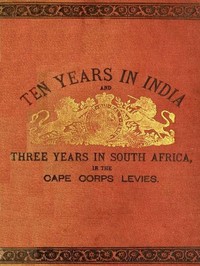
The source record for Ten Years in India, in the 16th Queen's Lancers, and Three Years in South Africa, in the Cape Corps Levies — Context and Discussion measures this digital text at 38,878 words, 2 hr 50 min estimated reading time, and 6 detected text sections.
The text analysis averages about 24.6 words per sentence, while the detected sections provide another way to judge how the source is divided.
Project Gutenberg metadata also associates the work with “South Africa -- Description and travel,” connecting these edition facts with the source record’s subject description.
Explore this collection
These alternatives are selected using recorded categories and estimated reading time.
About 168 minutes
Travel Narratives
38,469 recorded words. 2 minutes difference from this book's estimate.
View Gutenberg source #56438About 183 minutes
Travel Narratives
41,986 recorded words. 13 minutes difference from this book's estimate.
View Gutenberg source #57347About 218 minutes
Travel Narratives
49,997 recorded words. 48 minutes difference from this book's estimate.
View Gutenberg source #4068Search stored excerpts and compare books → Choose by your preferences →
Choices use stored catalog measurements. Estimates vary with reading speed. A shared category is a catalog label, not a claim that two books have the same argument or literary quality.
Search reads excerpt text stored with this catalog and links to its associated Gutenberg record. The connection is stored in the site database; this tool does not recheck that every excerpt is word-for-word identical to that external record. Excerpt search does not cover every chapter and does not verify historical publication dates.
Catalog snapshot checked: 2026-09-25. Coverage: 97 public books, 97 available source excerpts.
Calculated from edition completeness, EPUB availability, text structure and catalogue metadata. Not a user rating.
Total of 100 points, scaled to a 2.5-5.0 range. Editions with an empty description or a missing EPUB file are not scored.
Public-domain source text
The source text is kept in the dedicated reader, separate from this catalogue record and its commentary.
W. J. D. Gould opens his memoir with a preface that frames the work as a personal recollection, not a formal history. He recalls his father's war stories by the fireside in Brighton, which kindled his own desire to enlist. The dedication to the Marquis of Lorne signals the author's pride in his service with the 16th Queen's Lancers, a regiment he calls "The Terror of India." The title page lists six major battles—Ghuznee, Cabul, Maharajpoor, Buddewal, Aliwal, and Sobraon—along with the Kaffir War of 1850-51, promising a narrative "replete with anecdotes" and observations on the "manners and customs" of Indian and Kaffir peoples. This opening establishes a tone of personal testimony rather than official record.
Gould's writing is distinguished by its concrete, often surprising observations. In describing the hill tribes of the Himalayas, he notes that Ghoorkhas carry "three formidable knives in the shape of a sickle" and have been known to kill a tiger single-handed. He remarks that officers' families dress these small hill men "in Highland costume," a detail that reveals both cultural encounter and colonial domesticity. His description of the scenery around Simla and Missuri—"14,000 feet above the sea level," with glaciers reflecting "a thousand different colours"—is vivid but also practical: he notes the price of beetle specimens ("16 rupees or 32 shillings") and the use of mules as the only safe carrying animal. These details ground the exotic in the everyday economics of a soldier's life.
The account of the Battle of Sobraon (February 10, 1846) is notable for its blend of horror and incongruous humor. Gould describes the silent formation before daybreak, the opening mortar fire, and the roar of "over two hundred pieces of ordnance." Then an elephant is struck by a spent ball: "to see him cantering and galloping over that field, upsetting everything almost he came across was indeed a sight." The entire army bursts into laughter. A fox starts between the two armies, pursued by a soldier's dog, and the fox "stood some time confined, not knowing what way to get clear." These moments—the elephant's comic panic, the fox's confusion—cut through the expected gravity of battle narrative, revealing a soldier's eye for the absurd.
Between set-piece battles, Gould includes details that evoke the rhythm of campaign life. Marching to join Lord Gough, the villagers "generally welcomed us with salaams." At Sobraon, the army waited five days, "worried with picket and guard duty," for siege guns to be brought from Delhi by elephants. The enemy's position is described as a "half-moon, each horn resting on the Sutledge, with a bridge of boats in their rear." Such tactical notes sit alongside domestic observations: the availability of strawberries and nectarines on the hillsides, the use of jampanns (palanquins) to convey ladies, and the trade in leopard and bear skins. These details build a layered picture of a soldier's world, where the sublime and the mundane coexist.
Gould writes from the perspective of a non-commissioned officer—he signs himself "formerly Sergt. 16th Queen's Lancers." This vantage shapes his narrative: he records the reactions of the common soldier, not just the maneuvers of generals. The laughter at the wounded elephant, the fox chase, the mention of soldiers' dogs following them into battle—these are details unlikely to appear in official dispatches. His preface, too, emphasizes the oral tradition of storytelling around the hearth. The memoir thus preserves a rank-and-file voice, one that values anecdote and incident as much as strategic outcome. Readers should approach the text as a personal testimony, alert to what it reveals about the experiences and attitudes of a Victorian soldier.
Gould's memoir rewards a reading that attends to its incidental details—the price of beetles, the shape of a Ghoorkha knife, the fox caught between two armies. These observations, scattered among battle accounts, give the work its particular texture. Readers may find it useful to track how Gould shifts between the panoramic and the particular, and to note where his personal voice breaks through the expected conventions of military memoir. The book is less a comprehensive history than a collection of scenes from a soldier's life, shaped by memory and pride.
That rainy afternoon, I kept returning to Gould’s quiet observations of the long, dusty roads he marched—how a place becomes memory through walking. When the rain steadied, I set the memoir aside and picked up The Icknield Way — A Reader’s Guide. There it was again, that same patient rhythm of footsteps and landscape, though in entirely different boots. I think I smiled. Roads, after all, know no hurry.
Save your reaction, strongest insight, and memorable passage.