About 105 minutes
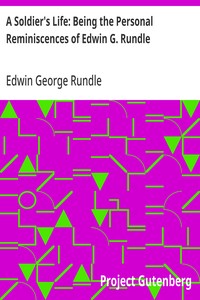
A Soldier's Life: Being the Personal Reminiscences of Edwin G. Rundle — Inside the Classic
Travel Narratives
24,122 recorded words. 9 minutes difference from this book's estimate.
View Gutenberg source #24665
This digital edition of Roughing It, Part 6. — Inside the Classic is described by source-level measurements including 26,149 words, 1 hr 54 min estimated reading time, and 4 detected text sections.
The text analysis averages about 23.7 words per sentence, while the detected sections provide another way to judge how the source is divided.
Project Gutenberg metadata also associates the work with “West (U.S.) -- Description and travel,” connecting these edition facts with the source record’s subject description.
Explore this collection
These alternatives are selected using recorded categories and estimated reading time.
About 105 minutes
Travel Narratives
24,122 recorded words. 9 minutes difference from this book's estimate.
View Gutenberg source #24665About 168 minutes
Travel Narratives
38,469 recorded words. 54 minutes difference from this book's estimate.
View Gutenberg source #56438About 170 minutes
Travel Narratives
38,878 recorded words. 56 minutes difference from this book's estimate.
View Gutenberg source #46823Search stored excerpts and compare books → Choose by your preferences →
Choices use stored catalog measurements. Estimates vary with reading speed. A shared category is a catalog label, not a claim that two books have the same argument or literary quality.
Search reads excerpt text stored with this catalog and links to its associated Gutenberg record. The connection is stored in the site database; this tool does not recheck that every excerpt is word-for-word identical to that external record. Excerpt search does not cover every chapter and does not verify historical publication dates.
Catalog snapshot checked: 2026-09-25. Coverage: 97 public books, 97 available source excerpts.
Calculated from edition completeness, EPUB availability, text structure and catalogue metadata. Not a user rating.
Total of 100 points, scaled to a 2.5-5.0 range. Editions with an empty description or a missing EPUB file are not scored.
Public-domain source text
The source text is kept in the dedicated reader, separate from this catalogue record and its commentary.
Twain opens this portion of Roughing It with a prefatory apology that is itself a performance: he claims the book is merely a personal narrative, not a pretentious history, yet insists that information stews out of him naturally, like the precious ottar of roses out of the otter. The tension between disavowing and delivering information runs through the chapters that follow. In Chapter LI, he describes being hired to write a novel for a new weekly—a novel he never finishes, but whose plot he summarizes with comic exasperation. The excerpts show Twain at his most self-deprecating, presenting himself as a dissolute author who cannot retain facts, yet who fills pages with precise, absurd details.
Twain recounts being engaged by the editor of the Weekly Occidental to write a novel, a task for which he claims to have no aptitude. He sketches the plot with deliberate flatness: a hero and heroine are separated by a villain, and the hero spends years searching for her. Twain’s summary is a parody of sentimental fiction, and he admits he lost interest after a few chapters. The episode reveals his ambivalence toward the conventions of popular literature—he can mimic them, but he cannot sustain them. The novel, he says, was abandoned, and the weekly soon failed. This self-mocking account of literary failure is typical of Twain’s persona in Roughing It: he presents himself as a hack who stumbles into adventures rather than a deliberate artist.
Three consecutive anecdotes in Chapter LV hinge on drunkenness and deception. The first involves a man who lets a hundred-pound brick fall on his foot—a foot he proves to be a cork leg—to cadge brandy from sympathetic bystanders. The second, titled “Ye Modest Man Taketh a Drink,” describes a bar patron who, after fumbling with a wet quarter, asks for a cigar instead of change. The third tells of a man who mistakes an iron dog for a real one, kicks it, and is flung head over heels. Each story is a miniature performance: the cork-leg man acts out pain, the modest man acts out embarrassment, and the iron-dog kicker acts out bravado followed by reflection. Twain’s delight in these set pieces lies in the gap between appearance and reality, and in the ingenuity of the drunk who turns a mishap into an opportunity.
Twain’s farewell to Virginia City is characteristically undercut by a digression. He mentions taking a last look at the flag atop Mount Davidson, “thirty-five feet long and ten feet wide,” fluttering like a lady’s handkerchief two thousand feet above the roofs. The image is both grand and absurd—a giant flag reduced to a handkerchief. This moment of genuine sentiment is immediately followed by the phrase “And this reminds me of an…” which trails off into the next anecdote. The structure suggests that Twain cannot sustain a solemn departure; his instinct is to puncture pathos with another story. The flag itself becomes a symbol of the book’s method: a large, conspicuous object that is also a pretext for comedy.
Readers should attend to the way Twain uses digression as a structural principle. The chapters are less a continuous narrative than a series of set pieces linked by association. The prefatory claim that information stews out of him is a clue: the book’s value lies not in its facts but in the comic pressure under which those facts are delivered. Treat each anecdote as a self-contained performance, and watch for the recurring pattern of a setup, a twist, and a punchline that undermines the initial premise.
Some evenings I think of Mark Twain’s boisterous, cork-legged drunkard, all bluster and brandy—and then I recall Rundle’s quieter ledger of army days, where hardship wore a similar face of stubborn cheer. Both men knew how a man spins his own legend to outlast the cold. That kinship sits warm on the shelf. A Soldier's Life: Being the Personal Reminiscences of Edwin G. Rundle — Inside the Classic keeps such honest company.
Use these questions to collect your thoughts before moving on.