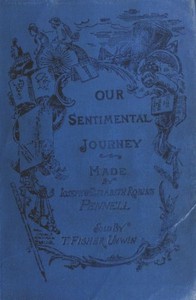
The Pennells' account of their tricycle journey from London to Rome is built on a deliberate structural tension: the authors repeatedly set up an expectation—whether of a famous site, a celebrated artist's haunt, or a picturesque road—only to undercut it with a mundane or disappointing reality. In Barbizon, for instance, they arrive expecting a true artists' inn but find instead a tourist show with an elegant waiter and inflated prices. This pattern of anticipation and revision gives the narrative a rhythm of discovery and disenchantment that is central to its character.
The Journey as a Series of Contrasts
The book's structure relies on sharp juxtapositions between the romantic ideal of travel and the practical experience of cycling. The Pennells preface their journey with a dedication to Laurence Sterne, invoking his Sentimental Journey, yet their own narrative often replaces Sterne's sentimental digressions with wry observations about overpriced drinks, lost directions, and the gap between artistic reputation and commercial reality. In the Forest of Fontainebleau, they deliberately ignore the waiter's explicit directions to find Millet's memorial rock, choosing instead to enjoy the road for its own beauty. This decision—to value the unplanned over the prescribed—becomes a recurring structural motif, as the authors privilege personal experience over tourist itineraries.
Recurring Images of Displacement and Disappointment
Certain images recur to signal the gap between expectation and reality. The waiter in a dress-coat at Barbizon is one such image: he embodies the commercialization of what the Pennells had hoped would be a rustic, authentic retreat. Similarly, the phrase “groseille” (redcurrant syrup) appears as a marker of overcharging—they pay double the usual price. These small, concrete details accumulate to create a texture of mild disillusionment. The forest itself is described through a quotation from Evelyn as “horrid and solitary,” yet the Pennells find it beautiful precisely because they ignore the “placarded places” that tourists are meant to visit. The image of the forest thus shifts from a site of prescribed sightseeing to one of personal, unmediated pleasure.
Movement Between Scenes: From Landscape to Art to Commerce
The narrative moves fluidly between three registers: landscape description, artistic reference, and commercial transaction. In the Barbizon section, the Pennells begin with the forest's natural beauty (heather, ferns, rocks), then pivot to Millet's suffering and Rousseau's legacy, and finally return to the mundane reality of paying the bill. This triadic movement—nature, art, money—structures many episodes. The authors do not linger in any one mode; instead, they cut quickly from the sublime to the practical, creating a restless, almost cinematic pacing. The effect is to remind the reader that even the most elevated artistic pilgrimage is grounded in the logistics of travel: finding a road, paying a waiter, deciphering directions.
The Role of the Tricycle as a Structural Device
The tricycle is not merely a mode of transport but a structural principle. The Pennells emphasize that they ride when possible and take boats or trains only when necessary—across the Channel or over the Alps. This alternation between cycling and other travel creates a rhythm of effort and ease, of direct engagement with the landscape versus passive conveyance. The tricycle also allows them to deviate from planned routes, as in the Forest of Fontainebleau, where they deliberately lose themselves. The vehicle thus enables a kind of wandering that is central to the book's structure: the journey is not a straight line from London to Rome but a series of detours, delays, and spontaneous choices. The preface's reference to “Pilgrims’ Progresses and Sentimental Journeys” frames the tricycle as a modern equivalent of the pilgrim's staff, a tool for both physical and narrative movement.
Readers attentive to the Pennells' structural choices will notice that the book's value lies not in its destination but in the accumulation of small, often ironic observations along the way. The authors' willingness to record disappointment alongside delight, and to let the journey's shape emerge from practical decisions rather than a predetermined itinerary, gives the narrative a distinctive, unvarnished quality. Approaching the text as a series of linked episodes rather than a continuous travelogue may best reveal its quiet humor and its commentary on the nature of modern pilgrimage.
That rainy afternoon, I kept returning to the Pennells’ careful contrasts—sunlit expectation against gritty reality—and it felt less like travel notes than a soldier’s quiet reckoning with memory. Later, almost by accident, I found A Soldier's Life: Being the Personal Reminiscences of Edwin G. Rundle — Inside the Classic, and the same unhurried honesty lingered there, like warm tea on a cold sill.