About 722 minutes
Through the Dark Continent, Vol. 1 (of 2) — A Closer Reading
Exploration
166,021 recorded words. 60 minutes difference from this book's estimate.
View Gutenberg source #75926
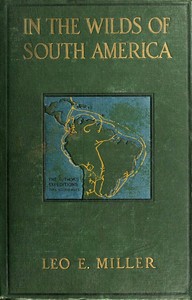
The source record for In the Wilds of South America — Text and Context measures this digital text at 152,091 words, 11 hr 2 min estimated reading time, and 32 detected text sections.
The text analysis averages about 26.2 words per sentence, while the detected sections provide another way to judge how the source is divided.
Project Gutenberg metadata also associates the work with “South America -- Description and travel,” connecting these edition facts with the source record’s subject description.
Explore this collection
These alternatives are selected using recorded categories and estimated reading time.
About 722 minutes
Exploration
166,021 recorded words. 60 minutes difference from this book's estimate.
View Gutenberg source #75926About 527 minutes
Exploration
121,147 recorded words. 135 minutes difference from this book's estimate.
View Gutenberg source #71643About 515 minutes
Exploration
118,402 recorded words. 147 minutes difference from this book's estimate.
View Gutenberg source #64461Search stored excerpts and compare books → Choose by your preferences →
Choices use stored catalog measurements. Estimates vary with reading speed. A shared category is a catalog label, not a claim that two books have the same argument or literary quality.
Search reads excerpt text stored with this catalog and links to its associated Gutenberg record. The connection is stored in the site database; this tool does not recheck that every excerpt is word-for-word identical to that external record. Excerpt search does not cover every chapter and does not verify historical publication dates.
Catalog snapshot checked: 2026-09-25. Coverage: 97 public books, 97 available source excerpts.
Calculated from edition completeness, EPUB availability, text structure and catalogue metadata. Not a user rating.
Total of 100 points, scaled to a 2.5-5.0 range. Editions with an empty description or a missing EPUB file are not scored.
Public-domain source text
The source text is kept in the dedicated reader, separate from this catalogue record and its commentary.
Leo E. Miller opens his narrative with a direct address to museum visitors, wondering how many imagine the living habits of displayed specimens. His preface establishes a dual purpose: to trace his six years of exploration across South America's major river systems and to convey the sensory reality of tropical jungles—the cough of jaguars, the scream of macaws, the hiss of a bushmaster. The opening immediately grounds the reader in the naturalist's perspective, where danger and wonder coexist.
The excerpts show Miller shifting between broad overview and specific incident. In the Pantanal region, he describes a five-hour ride through knee-deep water, past drying marshes where thousands of fish die and decompose, attracting jaguars and water birds. This blend of ecological observation and personal experience characterizes the work's approach throughout.
Miller consistently pairs scientific description with narrative incident. When discussing the giant ant-eater, he quotes Lydekker on its nocturnal habits and termite-hunting, then notes his own specimens' stomach contents—ants, termites, earth, and leaves—and the thick, gizzard-like stomach walls. He gently challenges the earlier authority by stating his belief that the animal is at least partially diurnal. This pattern recurs: Miller presents received knowledge, then tests it against his field observations.
The excerpts also reveal his attention to the practicalities of expedition life. At the Palmiras ranch, he describes the square of buildings with an open court where pigs and chickens roam, the surrounding marshes and papyrus swamp, and the half-wild cattle. The main object of that excursion was to obtain jaguars, and Miller recounts the hunt's organization: men sent to locate spoor, a motley cavalcade including mounted natives on steers, and a pack of dogs. The return is signaled by bugles, with natives lining up to inspect trophies. These details ground the narrative in specific, lived experience.
One of the most striking passages in the excerpts describes a drying lagoon in the Pantanal. Miller writes of myriads of imprisoned fish wriggling in thin mud, forming an almost solid mass, with numbers leaping out and the ground strewn with dead and dying by thousands. The stench is almost overpowering. He notes that numerous animals—opossums, coatis, tiger-cats, even jaguars—come at night to gorge, while water birds exact their share by day.
This scene exemplifies Miller's ability to capture both the spectacle and the ecological dynamics of a landscape. The description is precise: the fish are of many species, the mud records footprints, the birds are countless. It is a moment of concentrated natural history, where death and life are intertwined. Miller does not moralize or sentimentalize; he observes and records, letting the scene speak for itself. For a first-time reader, such passages signal that the book will offer not just adventure but attentive naturalism.
Miller's prose is direct and unadorned, favoring concrete nouns and active verbs. He writes of “the hoarse cough of the jaguar” and “the lightning-like thrust of the terrible bushmaster.” The preface lists incidents of the explorer's every-day life: visits to lagoons teeming with crocodiles, sojourns in gloomy forests, ascents of mountain ranges. This catalog establishes the book's scope while maintaining a matter-of-fact tone.
The excerpts suggest a structure that alternates between general description and specific episodes. After the preface, the narrative appears to follow the chronology of expeditions, with each region or habitat receiving focused attention. The Pantanal section, for instance, moves from arrival at the ranch to the jaguar hunt, with digressions on ant-eaters and bird life. Miller uses transitional phrases like “We spent the night aboard the Nyoac” to anchor the reader in time and place. This method gives the book a documentary quality, as if the reader is accompanying the expedition.
The excerpts provide several specific observations that a reader can use to gauge Miller's reliability and interests. He notes that the stomachs of ant-eaters shot by Colonel Roosevelt and his son contained ants, termites, earth, and bits of leaves, and that the stomach walls are thick and muscular like a gizzard. He also reports that in captivity they thrive on finely chopped meat—a practical detail from a working naturalist.
Another revealing moment is his comment on the inconsistency in Lydekker's account of the giant ant-eater's habits. Miller does not dismiss the earlier authority but gently corrects it based on his own experience. This suggests a writer who respects scientific tradition but trusts his eyes. The excerpts also show his attention to the human dimension of exploration: the motley cavalcade, the bugle signals, the natives lined up to see trophies. These details remind the reader that the naturalist's work is also a social and logistical endeavor.
Miller's narrative rewards a reader who pays attention to both the grand scenes and the small corrections. The book is not a systematic treatise but a field naturalist's account, shaped by the contingencies of travel and the habits of animals. A first-time reader might approach it as a series of expeditions, each with its own character, rather than a continuous story. The excerpts suggest that Miller's greatest strength lies in his ability to make the reader see what he saw—the fish dying in the mud, the ant-eater's gizzard, the bugle call across the marsh.
Reading about Miller's patient tracking through unfamiliar forest made me think of that other quiet endurance, the long search for Franklin's men in the Arctic. Both books share a strange respect for the land's silence, and how it keeps its secrets. In the Arctic Seas A Narrative of the Discovery of the Fate of Sir John Franklin and his Companions — Themes and Context stayed with me for that same reason.
Capture what you thought, learned, and would like to remember.