About 515 minutes
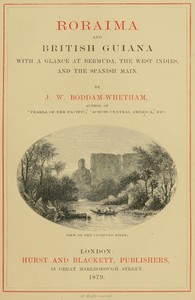
Roraima and British Guiana, With a Glance at Bermuda, the West Indies, and the Spanish Main — Background and Themes
Exploration
118,402 recorded words. 12 minutes difference from this book's estimate.
View Gutenberg source #64461
Life in the forests of the Far East (vol. 1 of 2) — Background and Themes can be approached with a clearer sense of reading commitment from its source measurements: 121,147 words, 8 hr 47 min estimated reading time, and 22 detected text sections.
The text analysis averages about 27.9 words per sentence, while the detected sections provide another way to judge how the source is divided.
Project Gutenberg metadata also associates the work with “Borneo -- Description and travel,” connecting these edition facts with the source record’s subject description.
Explore this collection
These alternatives are selected using recorded categories and estimated reading time.
About 515 minutes
Exploration
118,402 recorded words. 12 minutes difference from this book's estimate.
View Gutenberg source #64461About 476 minutes
Exploration
109,345 recorded words. 51 minutes difference from this book's estimate.
View Gutenberg source #13003About 428 minutes
Exploration
98,421 recorded words. 99 minutes difference from this book's estimate.
View Gutenberg source #37669Search stored excerpts and compare books → Choose by your preferences →
Choices use stored catalog measurements. Estimates vary with reading speed. A shared category is a catalog label, not a claim that two books have the same argument or literary quality.
Search reads excerpt text stored with this catalog and links to its associated Gutenberg record. The connection is stored in the site database; this tool does not recheck that every excerpt is word-for-word identical to that external record. Excerpt search does not cover every chapter and does not verify historical publication dates.
Catalog snapshot checked: 2026-09-25. Coverage: 97 public books, 97 available source excerpts.
Calculated from edition completeness, EPUB availability, text structure and catalogue metadata. Not a user rating.
Total of 100 points, scaled to a 2.5-5.0 range. Editions with an empty description or a missing EPUB file are not scored.
Public-domain source text
The source text is kept in the dedicated reader, separate from this catalogue record and its commentary.
St. John structures his account around a series of river journeys that carry the reader from coastal trading posts into the interior. The Tampasuk, the Quop, and other waterways serve as both literal routes and organizing principles, each ascent revealing a new layer of Dayak life. The author’s eye for material detail—the weave of a basket, the weight of a priestess’s brass girdle—gives the narrative a tactile quality. At the same time, he frequently interrupts description with anecdote: a story of rice’s origin, a priest’s sleight-of-hand, a floating pig’s trough. This alternation between systematic observation and local tale shapes the volume’s rhythm, making it less a continuous travelogue than a series of framed encounters.
The journey up the Tampasuk River introduces a pattern that recurs throughout the volume. St. John notes the changing vegetation, the appearance of rapids, and the increasing frequency of Dayak longhouses. Each river functions as a threshold: the coast belongs to Malay traders and European officials; the upper reaches belong to communities that the author presents as more autonomous. The river also governs the pace of the narrative. When the boat is stuck on a sandbank or the crew must haul it through shallows, the text slows to register the labor. When the current is strong, the prose quickens. This correlation between physical movement and narrative tempo is one of the volume’s most consistent structural features.
St. John devotes sustained attention to objects: the brass girdles worn by priestesses, the fine rattan baskets, the iron spearheads forged in village smithies. He describes not only appearance but also manufacture and use. A priestess’s costume is itemized—the “string of teeth, large hawk-bells and opaque beads” worn belt-fashion—and the account of a blacksmith’s work is folded into a broader survey of village economy. These passages ground the ethnographic observations in tangible things. The author rarely comments on the aesthetic quality of these objects; instead, he treats them as evidence of skill, trade, and social hierarchy. The effect is to make the reader aware of the material basis of Dayak life, from the rice harvest to the tools of ritual.
The excerpt concerning the origin of priestesses is one of the volume’s most extended narrative passages. St. John recounts a local story: two girls set adrift in a pig’s trough are rescued by the great “Iang,” who teaches them “the mysteries of religion, the formulas they were to chant, the taboo they were to observe.” The author then shifts to a skeptical description of contemporary priestly practice, noting that priests “pretend to meet and to converse with spirits” and extract stones from sick bodies. The juxtaposition is telling. St. John does not dismiss the origin story as mere superstition; he presents it as a foundation narrative that coexists with the pragmatic deceptions he observes. The section thus captures a tension between recorded belief and reported practice that runs through the volume.
St. John’s survey of Dayak economic life is organized by craft and crop. He lists the products of each village—baskets, mats, iron tools—and notes that “each man, moreover, is his own carpenter, gardener, and farmer.” The description of agriculture is similarly itemized: rice, Indian corn, cucumbers, bananas, sweet potatoes, sugar-cane, yams, beans. The author is interested in the division of labor and the circulation of goods. A priest’s fee of six gallons of uncleaned rice is compared to the sixtieth part of a laborer’s annual output, giving the reader a sense of relative value. These passages are among the most data-rich in the volume, and they reveal St. John’s training as a colonial administrator. He is less concerned with the romance of the forest than with the practical arrangements that sustain life within it.
Readers will find that the volume rewards attention to its transitions: the moment when a river narrows, when a story interrupts a list, when the author steps back from description to offer a comparative remark. St. John’s voice is that of a careful observer who is also a participant in the scenes he records. The result is a work that oscillates between the systematic and the anecdotal, and that invites the reader to consider how travel, trade, and belief intersect in a specific historical moment.
Reading St. John’s river passages through Borneo, I kept thinking of that other humid, green silence—his prose has the same patient weight as Roraima and British Guiana, With a Glance at Bermuda, the West Indies, and the Spanish Main — Background and Themes. Both feel less like travelogues and more like quiet, respectful footprints left along mud paths, each detail held gently, as if not to startle the memory itself.
Answer a few questions and save a private reflection on this device.