About 527 minutes
Life in the forests of the Far East (vol. 1 of 2) — Background and Themes
Exploration
121,147 recorded words. 12 minutes difference from this book's estimate.
View Gutenberg source #71643
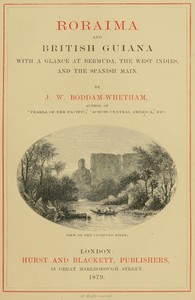
Before opening Roraima and British Guiana, With a Glance at Bermuda, the West Indies, and the Spanish Main — Background and Themes, the edition data offers a quick orientation: 118,402 words, 8 hr 35 min estimated reading time, and 37 detected text sections.
The text analysis averages about 25.5 words per sentence, while the detected sections provide another way to judge how the source is divided.
Project Gutenberg metadata also associates the work with “Guyana -- Description and travel,” connecting these edition facts with the source record’s subject description.
Explore this collection
These alternatives are selected using recorded categories and estimated reading time.
About 527 minutes
Exploration
121,147 recorded words. 12 minutes difference from this book's estimate.
View Gutenberg source #71643About 476 minutes
Exploration
109,345 recorded words. 39 minutes difference from this book's estimate.
View Gutenberg source #13003About 428 minutes
Exploration
98,421 recorded words. 87 minutes difference from this book's estimate.
View Gutenberg source #37669Search stored excerpts and compare books → Choose by your preferences →
Choices use stored catalog measurements. Estimates vary with reading speed. A shared category is a catalog label, not a claim that two books have the same argument or literary quality.
Search reads excerpt text stored with this catalog and links to its associated Gutenberg record. The connection is stored in the site database; this tool does not recheck that every excerpt is word-for-word identical to that external record. Excerpt search does not cover every chapter and does not verify historical publication dates.
Catalog snapshot checked: 2026-09-25. Coverage: 97 public books, 97 available source excerpts.
Calculated from edition completeness, EPUB availability, text structure and catalogue metadata. Not a user rating.
Total of 100 points, scaled to a 2.5-5.0 range. Editions with an empty description or a missing EPUB file are not scored.
Public-domain source text
The source text is kept in the dedicated reader, separate from this catalogue record and its commentary.
Boddam-Whetham opens his narrative with a confession: he was spurred to travel by a magazine article that called Roraima 'one of the greatest marvels and mysteries of the earth.' The preface reveals a tension between ambition and limitation—he hopes to 'at all events seeing Roraima and exploring its floral treasures, even if I should be unable to make its ascent.' This note of qualified expectation sets the tone for a journey that is as much about the struggle to reach the mountain as about the mountain itself.
The author joins a government-sponsored expedition, and his account is structured as a 'rough record' rather than a scientific report. The excerpts show a writer attentive to practical details: the strain on woodskins (dugout canoes), the constant loading and unloading, and the comic mishap of mistaking moonrise for dawn. These moments ground the narrative in the physical realities of travel.
The journey up the Curipung River is marked by a rhythm of obstruction and improvisation. Boddam-Whetham describes a 'perpetual jumping in and out, loading and unloading, lifting and hauling, pushing and carrying, cutting and squeezing.' Fallen trees force the party to unload boats, cut passages, and sometimes crouch helplessly as water pours in. Two woodskins split and are repaired with 'bark, linen, and paper.' The author’s tone is often wry: 'It was most amusing, and I never enjoyed a good laugh at McTurk’s expense without immediately finding myself in a similar position.'
The river itself is capricious—its windings so extreme that after following a southerly direction for a mile, the party might turn north again. This physical unpredictability mirrors the larger uncertainty of the expedition. The text does not reveal whether they ultimately reach the summit, but the emphasis on repeated setbacks suggests that the journey’s value lies in the attempt itself.
Boddam-Whetham’s observations of Indigenous peoples are filtered through a colonial lens, yet he records specific details: 'wild-looking creatures, hideously painted and stained,' with men whose hair is longer than the women’s. The Indians warn the party to turn back, 'shook their heads and groaned' at the mention of Roraima. The author does not elaborate on their reasons, leaving the reader to infer a gap between European curiosity and local knowledge.
Wildlife appears in vivid snapshots: Muscovy ducks are abundant but deemed inferior to ducklars, which are later regretted as wasted. The 'kwet-kwet' of the scarlet cotinga and the 'brilliant but harsh-voiced pompadour' are noted. Butterflies—'blue morphos and still more lovely butterflies of a sparkling violet hue'—float lazily under overhanging trees. These details accumulate into a sense of a landscape teeming with life, yet one that resists easy categorization.
Roraima itself remains largely absent from the excerpts, a looming presence that shapes the narrative without appearing directly. The preface quotes Sir Robert Schomburgh’s account of Indigenous traditions: 'the summits of the flat-topped gigantic sandstone walls… contain large lakes, full of remarkable fish-like dolphins, and continually encircled by gigantic white eagles.' This mythic description contrasts with the mundane difficulties of the journey—the mud, the mosquitoes, the broken boats.
The author’s stated goal is to 'add its mite in attracting the notice of travellers to a country not often visited for pleasure.' The mountain functions as a symbol of the unknown, a destination that may be inaccessible but whose allure justifies the effort. The text does not confirm whether the party ever sets foot on Roraima, leaving the reader to wonder if the mystery remains intact.
Readers should approach this narrative as a travel diary rather than a systematic exploration. Boddam-Whetham’s strength lies in his eye for incongruous detail—the moonrise mistaken for dawn, the casual repair of a canoe with paper. The book rewards those who enjoy the texture of Victorian travel writing: the mix of self-deprecation, curiosity, and colonial assumptions. For a fuller picture of the region’s natural history, consider supplementing this account with contemporary scientific reports.
The rain kept drumming on the roof while I followed Boddam-Whetham through the steaming forest, his river routes and dense green walls feeling utterly remote. Then a mention of another journey, just a passing note, sent me hunting for a grimmer tale of Arctic ice. In the Arctic Seas A Narrative of the Discovery of the Fate of Sir John Franklin and his Companions — Themes and Context sat unread beside the lamp, its chill a strange counterpoint to that wet afternoon.
Capture what you thought, learned, and would like to remember.