About 515 minutes
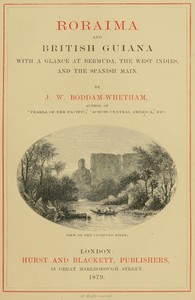
Roraima and British Guiana, With a Glance at Bermuda, the West Indies, and the Spanish Main — Background and Themes
Exploration
118,402 recorded words. 39 minutes difference from this book's estimate.
View Gutenberg source #64461
Pioneers in Canada — Reading Companion can be approached with a clearer sense of reading commitment from its source measurements: 109,345 words, 7 hr 56 min estimated reading time, and 12 detected text sections.
The text analysis averages about 27.5 words per sentence, while the detected sections provide another way to judge how the source is divided.
Project Gutenberg metadata also associates the work with “Canada -- History -- To 1763 (New France),” connecting these edition facts with the source record’s subject description.
Explore this collection
These alternatives are selected using recorded categories and estimated reading time.
About 515 minutes
Exploration
118,402 recorded words. 39 minutes difference from this book's estimate.
View Gutenberg source #64461About 428 minutes
Exploration
98,421 recorded words. 48 minutes difference from this book's estimate.
View Gutenberg source #37669About 527 minutes
Exploration
121,147 recorded words. 51 minutes difference from this book's estimate.
View Gutenberg source #71643Search stored excerpts and compare books → Choose by your preferences →
Choices use stored catalog measurements. Estimates vary with reading speed. A shared category is a catalog label, not a claim that two books have the same argument or literary quality.
Search reads excerpt text stored with this catalog and links to its associated Gutenberg record. The connection is stored in the site database; this tool does not recheck that every excerpt is word-for-word identical to that external record. Excerpt search does not cover every chapter and does not verify historical publication dates.
Catalog snapshot checked: 2026-09-25. Coverage: 97 public books, 97 available source excerpts.
Calculated from edition completeness, EPUB availability, text structure and catalogue metadata. Not a user rating.
Total of 100 points, scaled to a 2.5-5.0 range. Editions with an empty description or a missing EPUB file are not scored.
Public-domain source text
The source text is kept in the dedicated reader, separate from this catalogue record and its commentary.
Sir Harry Johnston's Pioneers in Canada (1912) opens with a preface that frames the work as a series of 'real adventures' intended to illustrate 'the first coming of the white race' into regions inhabited by peoples of different skin colors. This framing immediately establishes a colonial perspective, yet Johnston also promises to 'tell the plain truth, even if here and there they showed the white man to have behaved badly.' The tension between imperial celebration and a stated commitment to honesty shapes the book's diction and descriptive choices throughout.
Johnston frequently incorporates lengthy quotations from earlier explorers and traders, such as Alexander Henry the Elder and Sir Alexander Mackenzie. These embedded voices provide direct testimony about Indigenous customs, but the author's own commentary often frames them within a civilizational hierarchy. The result is a layered text where the reader must distinguish between the reported observations of historical figures and Johnston's editorializing.
Johnston's word choices consistently position European explorers as active agents and Indigenous peoples as passive subjects. In the preface, he describes white men 'standing out clearly against backgrounds of unfamiliar landscapes, peopled with strange nations, savage tribes.' The adjectives 'strange' and 'savage' recur, reinforcing a dichotomy between civilized and primitive. However, Johnston also uses more neutral terms like 'Amerindians' and occasionally acknowledges Indigenous knowledge, as when he notes that children 'acquire, as it were 'by instinct', an astonishing dexterity' with bows and arrows. This mix of derogatory and appreciative language reflects the author's conflicted stance.
When describing the treatment of women, Johnston employs stark, almost clinical diction: 'the husband as likely as not killed and ate a wife; perhaps did this before slaying and eating a valuable dog.' The parallel structure ('killed and ate' vs. 'slaying and eating') emphasizes the brutality he wishes to highlight, yet the matter-of-fact tone distances the reader from emotional engagement.
Johnston relies heavily on quoted passages from earlier writers, a technique that lends authenticity but also creates a polyphonic text. For example, he reproduces Alexander Henry's description of Ojibwé child-rearing, where a boy might 'strike his father and spit in his face, calling him 'bad dog', or 'old woman'.' The quoted dialogue captures the father's indulgent response, which Henry reports with apparent astonishment. Johnston does not correct or moralize here; he lets the quotation stand, allowing the reader to infer cultural difference.
Similarly, Mackenzie's account of finger amputation during mourning is given verbatim: 'Many of the old women have so often repeated this ceremony that they have not a complete finger remaining on either hand.' Johnston's editorial voice remains minimal, trusting the shocking detail to speak for itself. This technique of embedding firsthand testimony gives the narrative an ethnographic texture, though the selection of which voices to include inevitably reflects Johnston's own priorities.
Johnston's descriptions of the Canadian landscape are sparse compared to his attention to human actions. When he does describe setting, it often serves as a backdrop for hardship or danger. For instance, he notes that during journeys, travellers 'are frequently obliged to lean against a tree for a small degree of temporary relief.' The focus is on physical endurance rather than scenic beauty. This utilitarian description aligns with the book's emphasis on survival and exploration.
In contrast, encounters with Indigenous people are described in vivid, often sensational terms. The account of women being forced to nurse bear cubs is presented without contextualizing the practice's spiritual or economic rationale. Johnston's descriptive choices here prioritize the exotic and shocking, potentially reinforcing stereotypes. Yet he also includes counter-examples, such as the 'kind treatment of children by fathers as well as mothers' which he calls 'an 'Indian' trait commented on by writer after writer.' This balancing act suggests an attempt at fairness within the limits of his perspective.
The book's structure follows a chronological sequence of exploration, but Johnston frequently interrupts the narrative with ethnographic digressions. These sections, such as the detailed account of mourning practices, are not always integrated into the main story. This creates a tension between the adventure narrative and the anthropological impulse. The preface explicitly states the series aims to show 'how the European was received, and how he treated these races,' yet the digressions often focus more on Indigenous customs than on European actions.
Johnston also uses illustrations by E. Wallcousins, though the excerpts do not describe them. The inclusion of colour plates suggests an intended audience interested in visual as well as textual representation. The overall structure—preface, then chapters likely organized by explorer or region—reflects a pedagogical aim, positioning the book as both entertainment and education for a young readership.
Readers approaching Pioneers in Canada should attend to the interplay between Johnston's own voice and the quoted sources. The book is not a single narrative but a compilation of testimonies filtered through an early twentieth-century imperial lens. Noticing when Johnston editorializes and when he lets others speak reveals the assumptions underlying his project. For a fuller understanding, compare his accounts with modern Indigenous histories and the original journals he cites.
There’s something about the way old narratives carry their silences—like how Johnston’s word choices in Pioneers in Canada linger, almost unintentionally. I felt that same quiet weight reading Through the Mackenzie Basin A Narrative of the Athabasca and Peace River Treaty Expedition of 1899 — Text and Context, where the landscape and the people’s voices seem to hold their own pace, unhurried. It stays with you, softly, like a half-remembered place.
A brief reflection can help important ideas stay with you longer.