About 251 minutes
The Circe of the deserts — Key Ideas to Explore
Geography
57,680 recorded words. 9 minutes difference from this book's estimate.
View Gutenberg source #69806
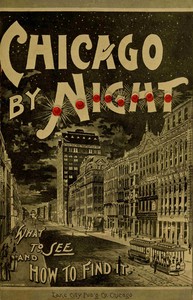
The catalog record for Chicago by day and night — Reading Companion provides practical reading context through 55,508 words, 4 hr 2 min estimated reading time, and 43 detected text sections.
The text analysis averages about 22.8 words per sentence, while the detected sections provide another way to judge how the source is divided.
Project Gutenberg metadata also associates the work with “World's Columbian Exposition (1893 : Chicago, Ill.),” connecting these edition facts with the source record’s subject description.
Explore this collection
These alternatives are selected using recorded categories and estimated reading time.
About 251 minutes
Geography
57,680 recorded words. 9 minutes difference from this book's estimate.
View Gutenberg source #69806About 253 minutes
Geography
58,160 recorded words. 11 minutes difference from this book's estimate.
View Gutenberg source #64166About 227 minutes
Geography
52,119 recorded words. 15 minutes difference from this book's estimate.
View Gutenberg source #67960Search stored excerpts and compare books → Choose by your preferences →
Choices use stored catalog measurements. Estimates vary with reading speed. A shared category is a catalog label, not a claim that two books have the same argument or literary quality.
Search reads excerpt text stored with this catalog and links to its associated Gutenberg record. The connection is stored in the site database; this tool does not recheck that every excerpt is word-for-word identical to that external record. Excerpt search does not cover every chapter and does not verify historical publication dates.
Catalog snapshot checked: 2026-09-25. Coverage: 97 public books, 97 available source excerpts.
Calculated from edition completeness, EPUB availability, text structure and catalogue metadata. Not a user rating.
Total of 100 points, scaled to a 2.5-5.0 range. Editions with an empty description or a missing EPUB file are not scored.
Public-domain source text
The source text is kept in the dedicated reader, separate from this catalogue record and its commentary.
Harold R. Vynne's Chicago by Day and Night (1892) presents itself as a practical guide for the visitor to the World's Columbian Exposition, but its tone and content reveal a more complex purpose. The subtitle—'The Pleasure Seeker's Guide to the Paris of America'—signals an ambition to catalog both respectable attractions and the city's more dubious entertainments. Vynne writes with the brisk authority of a seasoned urbanite, offering precise details on hotel prices, theatre seating, and hackmen's legal fares, while also warning readers of 'traps set by the wicked for the unwary.' The book's structure, moving from hotels and theatres to gambling haunts and 'adventuresses,' suggests a moral geography as much as a physical one.
Vynne's prose oscillates between boosterish description and cautionary advice. In the parks chapter, he paints an idyllic nighttime scene—'the moon is shedding an indulgent light down upon the merry-makers'—only to remind readers that 'far away in the distance… is the great city, teeming with life, turmoil and wickedness.' This duality pervades the book: the same author who extols the Auditorium's grandeur devotes a chapter to 'perils and pitfalls.' The guidebook's voice is that of a worldly cicerone who knows the city's pleasures and its dangers, and who trusts his reader to navigate both with open eyes.
Vynne's word choices reflect a confident familiarity with Chicago's social landscape. He refers to burlesque theatres as featuring 'beautiful belles of burlesque,' and describes gambling as 'the process of parting the fool and his money.' His chapter titles employ a knowing, slightly arch tone: 'The Tiger and its Haunts' for gambling, 'As to Adventuresses' for confidence women. This insider's lexicon—'cabby,' 'betting-rings,' 'phaetons'—assumes a reader who is not entirely naive, but who may need guidance in distinguishing the reputable from the disreputable. The diction itself becomes a tool of moral navigation.
The book's arrangement creates an implicit hierarchy of respectability. It opens with hotels and theatres—the proper visitor's first concerns—then moves to churches, panoramas, and parks. Only later does it address gambling, masquerades, and 'adventuresses.' This sequence suggests a descending scale of propriety, from the Palmer House to the 'free and easy shows.' Yet Vynne does not condemn outright; he describes these lower haunts with the same factual precision he applies to the Auditorium. The structure itself becomes a kind of moral itinerary, guiding the reader through concentric circles of urban experience, from the safe center to the perilous periphery.
Throughout the excerpts, Vynne attends to the physical mechanisms of city life: the 'phaetons' that make a circuit of the parks for 25 cents, the 'sea wall and promenade' on the lake, the 'betting-rings' at race tracks. He notes that the boulevard system 'extends completely around the city' and that 'it is impossible to lose one's way.' These recurring details of transportation, architecture, and commerce ground the guidebook in tangible, navigable space. They also reveal an author who understands that a city's character is expressed in its infrastructure—that the way a place moves people and money is as telling as its monuments or its vices.
Readers approaching Chicago by Day and Night should attend to the tension between its roles as practical handbook and moral commentary. Vynne's guide is most revealing not in its factual listings but in the gaps between them—the places where description shades into warning, or where the 'pleasure seeker' is reminded of the city's darker currents. The book offers a portrait of a city in transition, on the eve of the World's Fair, seen through the eyes of a guide who is both enthusiast and sentinel.
There is a particular warmth in Mr. Vynne’s brisk warnings about gaslit alleys and gilded lobbies, a fondness for the city’s honest clamor. It reminds me of another steady companion, one that maps a different frontier with the same patient hand. Both speak of place as memory, of paths walked with open eyes. The pillars of Hercules — Edition Insights holds that same quiet, knowing gaze.
Your answers remain private and are stored only in this browser.