About 201 minutes
The great beach — Background and Themes
Geography
46,033 recorded words. 2 minutes difference from this book's estimate.
View Gutenberg source #75895
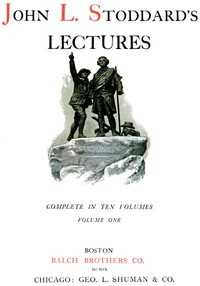
John L. Stoddard's Lectures, Vol. 01 (of 10) Norway, Switzerland, Athens, Venice — A Closer Reading can be approached with a clearer sense of reading commitment from its source measurements: 45,615 words, 3 hr 19 min estimated reading time, and 15 detected text sections.
The text analysis averages about 19.0 words per sentence, while the detected sections provide another way to judge how the source is divided.
Project Gutenberg metadata also associates the work with “Switzerland -- Description and travel,” connecting these edition facts with the source record’s subject description.
Explore this collection
These alternatives are selected using recorded categories and estimated reading time.
About 201 minutes
Geography
46,033 recorded words. 2 minutes difference from this book's estimate.
View Gutenberg source #75895About 206 minutes
Geography
47,290 recorded words. 7 minutes difference from this book's estimate.
View Gutenberg source #66205About 214 minutes
Geography
49,192 recorded words. 15 minutes difference from this book's estimate.
View Gutenberg source #67784Search stored excerpts and compare books → Choose by your preferences →
Choices use stored catalog measurements. Estimates vary with reading speed. A shared category is a catalog label, not a claim that two books have the same argument or literary quality.
Search reads excerpt text stored with this catalog and links to its associated Gutenberg record. The connection is stored in the site database; this tool does not recheck that every excerpt is word-for-word identical to that external record. Excerpt search does not cover every chapter and does not verify historical publication dates.
Catalog snapshot checked: 2026-09-25. Coverage: 97 public books, 97 available source excerpts.
Calculated from edition completeness, EPUB availability, text structure and catalogue metadata. Not a user rating.
Total of 100 points, scaled to a 2.5-5.0 range. Editions with an empty description or a missing EPUB file are not scored.
Public-domain source text
The source text is kept in the dedicated reader, separate from this catalogue record and its commentary.
John L. Stoddard's lecture on Switzerland opens with a dramatic account of a near-fatal storm on the Great St. Bernard Pass, where he mistakes a dead-house for a shelter. This anecdote sets the tone for a work that oscillates between personal peril and reverent observation. Stoddard's prose is marked by a theatrical sensibility, as when he describes glaciers as "glittering serpents" or contrasts the warmth of the hospice with the "baffled storm." The lecture is not a dry geographical survey but a performance of wonder, aimed at an audience that may never travel to these sites.
Stoddard's account of the St. Bernard hospice relies on a contrast between mortal danger and monastic refuge. He emphasizes the "ghastly spectacle" of travelers' bones preserved by the dry air, then pivots to the "blessed" reception by the brothers. This juxtaposition of horror and hospitality recurs in his description of glaciers as "monstrous" yet beautiful. The dogs of St. Bernard are praised for their "courage and intelligence," but the passage dwells on the fragility of life at altitude. Stoddard notes that the lake near the hospice is too cold for fish, so no birds visit—a detail that underscores the isolation. The lecture thus uses specific, sensory details to evoke the sublime, a key aesthetic category for 19th-century travel writing.
In the preface, Stoddard quotes a French abbé who keeps a country seat he never visits, arguing that most people live in anticipation of happiness elsewhere. This frames the lecture as a substitute for actual travel. Stoddard's first-person narrative—"I faltered," "I heard my guide exclaim"—positions him as a proxy for the armchair traveler. He addresses the reader directly, assuming a shared desire to visit Europe. The lecture's structure, with its dramatic peaks and moralizing conclusions (e.g., the brothers' reward in heaven), mirrors the conventions of the lyceum circuit. Stoddard was a professional lecturer, and the text retains the rhythms of spoken performance: exclamations, rhetorical questions, and vivid contrasts.
Despite the title's promise of four destinations, the excerpts focus almost exclusively on Switzerland. Norway, Athens, and Venice are mentioned only in the catalog metadata. The Swiss section itself is selective: Stoddard lingers on the St. Bernard Pass and Chamonix but skips other regions. His descriptions are shaped by literary and artistic conventions—the picturesque valley, the sublime glacier—rather than systematic geography. He mentions the "humble peasants" who cross the pass but offers no economic or political context. The lecture thus reflects the tastes of a late-19th-century American audience, more interested in dramatic scenery and moral uplift than in comprehensive survey. Readers should note that the volume's scope is narrower than its title suggests.
Stoddard's lectures reward readers who appreciate ornate, emotionally charged prose and a pre-modernist sensibility. The text is best approached as a period piece, revealing how travel was packaged for popular consumption in the 1890s. Pay attention to the rhetorical devices—exclamation points, direct address, and moralizing asides—that signal the lecture's origins on the stage. The volume's uneven coverage of its four subjects is itself instructive, showing what a well-known lecturer chose to emphasize for his audience.
That rainy afternoon, Stoddard’s Norway seemed all fiords and gloom. But the way he paused at Athens—a city layered by centuries—lingered with me. By evening, I was imagining other buried places, and my hand found another worn volume, The cave dwellers of Southern Tunisia — A Closer Reading. Same quiet wonder: people carving homes from stone, living inside time.
A brief reflection can help important ideas stay with you longer.