About 267 minutes
The Hastings Road and the "Happy Springs of Tunbridge" — Themes and Context
Geography
61,374 recorded words. 5 minutes difference from this book's estimate.
View Gutenberg source #58909
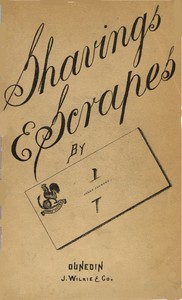
This digital edition of Shavings & Scrapes from many parts — Reading Companion is described by source-level measurements including 62,510 words, 4 hr 32 min estimated reading time, and 40 detected text sections.
The text analysis averages about 25.8 words per sentence, while the detected sections provide another way to judge how the source is divided.
Project Gutenberg metadata also associates the work with “Pacific Area -- Description and travel,” connecting these edition facts with the source record’s subject description.
Explore this collection
These alternatives are selected using recorded categories and estimated reading time.
About 267 minutes
Geography
61,374 recorded words. 5 minutes difference from this book's estimate.
View Gutenberg source #58909About 267 minutes
Geography
61,406 recorded words. 5 minutes difference from this book's estimate.
View Gutenberg source #64060About 282 minutes
Geography
64,745 recorded words. 10 minutes difference from this book's estimate.
View Gutenberg source #76702Search stored excerpts and compare books → Choose by your preferences →
Choices use stored catalog measurements. Estimates vary with reading speed. A shared category is a catalog label, not a claim that two books have the same argument or literary quality.
Search reads excerpt text stored with this catalog and links to its associated Gutenberg record. The connection is stored in the site database; this tool does not recheck that every excerpt is word-for-word identical to that external record. Excerpt search does not cover every chapter and does not verify historical publication dates.
Catalog snapshot checked: 2026-09-25. Coverage: 97 public books, 97 available source excerpts.
Calculated from edition completeness, EPUB availability, text structure and catalogue metadata. Not a user rating.
Total of 100 points, scaled to a 2.5-5.0 range. Editions with an empty description or a missing EPUB file are not scored.
Public-domain source text
The source text is kept in the dedicated reader, separate from this catalogue record and its commentary.
Jules Joubert’s Shavings & Scrapes from many parts opens not with a voyage but with a naming crisis. The author confesses that his publisher rejected “Ups and Downs” and “A Random Shot” as already taken; only a servant’s coal-scuttle shavings, tossed onto the fire, inspire the title. This self-mocking anecdote sets the tone for a memoir that treats its own composition as a near-comic accident. The book’s contents page reveals a loose geographical structure—early Australian “scrapes,” then New Caledonia, Ceylon, India—but the excerpts suggest that individual scenes, not chronology, drive the narrative. Readers should expect digressions, abrupt transitions, and a narrator who is as interested in his own missteps as in the places he describes.
The first chapter, titled “The Christening,” is a sustained joke about the difficulty of finding a title. Joubert lists rejected options—each too long, too short, or already used—and claims he nearly burned the manuscript in frustration. The coal-scuttle shavings that save the pages also supply the name: “Shavings and Scrapes,” which he calls “original, though slightly Barber ous.” The pun on “barberous” (barber + barbarous) is typical of his wordplay. This opening frames the entire work as a rescued accident, inviting readers to treat the chapters that follow as casually assembled. The anecdote also establishes Joubert’s persona: a narrator who is self-deprecating, resourceful, and fond of domestic details. He describes the christening as “a private affair, settled au coin du feu,” emphasizing the fireside intimacy of the decision. For a first-time reader, this chapter signals that the book values wit over systematic travelogue.
In the Ceylon section, Joubert attends a wedding that quickly becomes claustrophobic. The bride’s house is “not many feet square” yet holds forty people; the narrator feels trapped, with “indistinct ideas of the Black Hole of Calcutta” crossing his mind. The description dwells on physical discomfort: heat, “Oriental odours,” and the bridegroom appearing “very hot and very shiny” after cooking. Joubert’s eye for incongruous detail—the verandah decorated like “a cross between a fairy-bower and a Covent Garden fruit-stall”—turns the scene into a comedy of manners. He notes that the bride stares at the floor “hard enough to penetrate through the bricks,” while the company stares at him. The passage is notable for its sustained irony: Joubert presents himself as a reluctant participant, yet his vivid rendering of the chaos suggests genuine engagement. Readers should note how the narrator’s discomfort becomes a lens for observing social rituals.
The table of contents lists forty chapters grouped by region, but the excerpts reveal no overarching argument or chronological thread. Joubert moves from “A Stray Shot” to “Peep of Day” to “Chip from an Old Log” without explaining connections. The title itself—Shavings & Scrapes—implies leftovers, fragments. This structural looseness is deliberate: the author presents his experiences as unpolished bits, saved from the fire by chance. Readers accustomed to linear travel narratives may need to adjust expectations. The book rewards those who treat each chapter as a self-contained sketch. Joubert’s voice remains consistent—wry, observant, occasionally exasperated—but the settings shift abruptly. The lack of transitions means that the reader must supply the links, or simply enjoy the variety. The final pages of the Project Gutenberg file revert to legal boilerplate, a reminder that the text itself is a digital salvage operation.
Joubert’s position as a European traveler in the Pacific and Asia is never interrogated, but his anecdotes often highlight his own awkwardness. In the wedding scene, he is the only outsider, forced to “hand, or rather drag the bride to one end of the table.” He describes himself as a helpless observer, “resigned to my fate; escape was out of the question.” This posture recurs: in earlier chapters, he survives a stray shot, a gold rush, and bushrangers, always with a tone of narrow escape. The book does not moralize about colonialism; instead, it records the narrator’s personal scrapes. Readers interested in historical attitudes will find implicit assumptions about race and class, but Joubert rarely pauses to reflect. His focus is on the immediate scene—the heat, the crowd, the smell. This makes the memoir a useful primary source for everyday colonial life, filtered through a narrator who is more concerned with his own comfort than with analysis.
Because the excerpts are drawn from the beginning, middle, and end of the book, they offer a fair sample of Joubert’s method. Readers should expect a patchwork of episodes rather than a continuous story. The author’s voice—self-mocking, observant, sometimes flustered—is the thread that holds the fragments together. Treat each chapter as a standalone sketch, and the book as a cabinet of curiosities rather than a guided tour.
There’s something tender about Joubert’s crowded wedding feast, bodies pressed together in a heat that makes the past feel almost touchable. So I lingered over the Voyages of the Dutch brig of war Dourga — Reading Notes next, hoping for that same unhurried intimacy in unfamiliar waters. Some collections ask nothing, and simply hold their stories open like a hand.
Capture what you thought, learned, and would like to remember.