About 114 minutes
Narrative of a Recent Imprisonment in China after the Wreck of the Kite — Story, Setting & Ideas
Geography
26,149 recorded words. 2 minutes difference from this book's estimate.
View Gutenberg source #60335
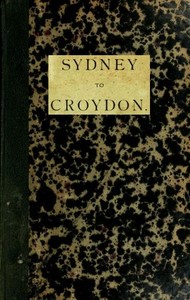
This digital edition of Sydney to Croydon (Northern Queensland) An Interesting Account of a Journey to the Gulf Country with a Member of Parliament — A Reader’s Guide is described by source-level measurements including 26,630 words, 1 hr 56 min estimated reading time, and 3 detected text sections.
The text analysis averages about 37.5 words per sentence, while the detected sections provide another way to judge how the source is divided.
Project Gutenberg metadata also associates the work with “New South Wales -- Description and travel,” connecting these edition facts with the source record’s subject description.
Explore this collection
These alternatives are selected using recorded categories and estimated reading time.
About 114 minutes
Geography
26,149 recorded words. 2 minutes difference from this book's estimate.
View Gutenberg source #60335About 122 minutes
Geography
28,000 recorded words. 6 minutes difference from this book's estimate.
View Gutenberg source #60006About 122 minutes
Geography
28,053 recorded words. 6 minutes difference from this book's estimate.
View Gutenberg source #74413Search stored excerpts and compare books → Choose by your preferences →
Choices use stored catalog measurements. Estimates vary with reading speed. A shared category is a catalog label, not a claim that two books have the same argument or literary quality.
Search reads excerpt text stored with this catalog and links to its associated Gutenberg record. The connection is stored in the site database; this tool does not recheck that every excerpt is word-for-word identical to that external record. Excerpt search does not cover every chapter and does not verify historical publication dates.
Catalog snapshot checked: 2026-09-25. Coverage: 97 public books, 97 available source excerpts.
Calculated from edition completeness, EPUB availability, text structure and catalogue metadata. Not a user rating.
Total of 100 points, scaled to a 2.5-5.0 range. Editions with an empty description or a missing EPUB file are not scored.
Public-domain source text
The source text is kept in the dedicated reader, separate from this catalogue record and its commentary.
Saltbush's 1889 account of a journey from Sydney to the Croydon goldfield is neither a dry geographical survey nor a booster's pamphlet, despite its cataloging under 'Description and travel' and 'Gold mines and mining.' The opening pages establish a practical, first-person voice: the narrator decides to visit after receiving letters from 'an old mate' who extols the field's 'richness and permanency.' The narrative immediately grounds itself in concrete logistics—booking berths on the steamer Namoi, packing light, and securing the services of steward 'Alick.' This attention to the mechanics of travel, rather than to gold yields or landscape description, shapes the book's character.
The catalog subject 'New South Wales -- Description and travel' and 'Queensland -- Description and travel' might suggest scenic description, but Saltbush focuses on the transport network. The journey is a chain of steamships, trains, and river tenders, each named and timed: the Namoi to Newcastle, the Northern train, the Dugong up the Norman River. The narrator notes the 'circuitous channel' marked by buoys, the lightship at the river mouth, and the 'steam tender' that transfers passengers. These details reveal a colonial infrastructure still being built—the ship carrying 'rails for the Gulf railway' anchors offshore, awaiting lighters. The traveler's perspective is that of a participant in a system that is functional but not yet seamless.
The catalog subject 'Gold mines and mining -- Australia -- Croydon (Qld.)' is present, but the excerpts show it filtered through personal correspondence and investment speculation. The narrator's friend describes Croydon as 'the grandest goldfield ever discovered in Northern Queensland,' a claim the narrator wants to 'judge for myself.' The journey is framed as a reconnaissance for 'investment,' not a miner's quest. The book's subtitle promises 'An Interesting Account of a Journey to the Gulf Country with a Member of Parliament,' yet the excerpts do not name or quote this MP. The goldfield functions as a destination and a lure, but the narrative's energy goes into the travel itself, not into mining operations or geology.
One of the most vivid passages in the excerpts is a first-person account of an underwater fight with a shark while diving. The narrator describes kicking the shark 'fairly in the head' and wrapping a bag around his hand when the shark 'came at me like a bulldog.' The episode is told with precise, almost comic detail—the dagger in a 'watertight case' that must be turned 'four times in the sheath' to draw. This digression is not about gold or travel logistics; it is a standalone adventure story. Such anecdotes suggest that Saltbush's book is as much a collection of entertaining incidents as a travelogue, and that the catalog subjects do not capture the work's full range of content.
Readers approaching this book through its catalog subjects should expect a narrative that is more personal and anecdotal than systematic. Saltbush writes as a practical traveler, noting the names of stewards, the timing of tides, and the feel of a shark's tail. The goldfield is a goal, but the journey itself—and the stories it generates—is the real subject. The book rewards those who enjoy period detail and digressive yarns over those seeking a comprehensive guide to northern Queensland.
I have handled both volumes many times, each one a traveller's honest account. The Queensland journey, with its dusty goldfields and patient observations, always reminds me of another chronicler, one who walked older roads. There is a shared, unhurried way of noting what matters—water, temples, and the quiet endurance of place. Hello, old friend Pausanias' description of Greece, Volume I. — Themes and Context; you both know the value of a well-told mile.
Answer a few questions and save a private reflection on this device.