About 214 minutes
Sussex, Painted by Wilfrid Ball — A Closer Reading
Geography
49,192 recorded words. 2 minutes difference from this book's estimate.
View Gutenberg source #67784
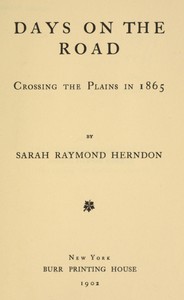
Before opening Days on the Road: Crossing the Plains in 1865 — Text and Context, the edition data offers a quick orientation: 49,678 words, 3 hr 36 min estimated reading time, and 11 detected text sections.
The text analysis averages about 16.6 words per sentence, while the detected sections provide another way to judge how the source is divided.
Project Gutenberg metadata also associates the work with “West (U.S.) -- Description and travel,” connecting these edition facts with the source record’s subject description.
Explore this collection
These alternatives are selected using recorded categories and estimated reading time.
About 214 minutes
Geography
49,192 recorded words. 2 minutes difference from this book's estimate.
View Gutenberg source #67784About 226 minutes
Geography
51,944 recorded words. 10 minutes difference from this book's estimate.
View Gutenberg source #59608About 206 minutes
Geography
47,290 recorded words. 10 minutes difference from this book's estimate.
View Gutenberg source #66205Search stored excerpts and compare books → Choose by your preferences →
Choices use stored catalog measurements. Estimates vary with reading speed. A shared category is a catalog label, not a claim that two books have the same argument or literary quality.
Search reads excerpt text stored with this catalog and links to its associated Gutenberg record. The connection is stored in the site database; this tool does not recheck that every excerpt is word-for-word identical to that external record. Excerpt search does not cover every chapter and does not verify historical publication dates.
Catalog snapshot checked: 2026-09-25. Coverage: 97 public books, 97 available source excerpts.
Calculated from edition completeness, EPUB availability, text structure and catalogue metadata. Not a user rating.
Total of 100 points, scaled to a 2.5-5.0 range. Editions with an empty description or a missing EPUB file are not scored.
Public-domain source text
The source text is kept in the dedicated reader, separate from this catalogue record and its commentary.
Sarah Raymond Herndon's Days on the Road: Crossing the Plains in 1865 is structured as a daily journal, moving from Nebraska City toward Montana. The narrative alternates between expansive vistas and narrow, threatening spaces—mountain tops, cañons, and camp perimeters. A recurring pattern is the act of marking presence: cutting names in stone, watching for Indians, and noting graves. The journal's voice shifts between quiet reflection and alert observation, as when Herndon enjoys reading Stepping Heavenward on a Sunday afternoon, only to be reminded by companions that Indians could have carried her off unseen.
The journal repeatedly contrasts open plains with enclosed cañons. Herndon describes riding to a mountain top for a 'magnificently grand' view, then descending into narrow cañons where 'great rocks were hanging overhead on one side, with a rushing stream beside.' This spatial alternation creates a rhythm of expansion and contraction. The camp itself becomes a temporary enclosure; on Sunday, Herndon seeks solitude away from camp, but the men's watchfulness reasserts the boundary. The McMahan train's 'portable engine' serves as a symbolic enclosure of protection, its iron pipes interpreted by Indians as a weapon. The structure thus mirrors the emigrants' need to control space while being vulnerable within it.
Stone appears as both a medium for memory and a marker of danger. Herndon cuts her name in soft stone atop a mountain, joining 'hundreds of names' left by previous travelers. Yet stone also forms the graves of men killed by Indians, a 'sad fate' she hopes to avoid. Water, too, is dual: beautiful waterfalls in cañons contrast with the rushing stream beside the road, a potential hazard. The act of watching water—'standing watching one of the highest'—is interrupted by a stuttering command to move on. These elements recur not as mere description but as anchors for the journal's emotional register, linking the sublime to the mortal.
A distinctive narrative thread involves the McMahan train's 'portable engine' and iron pipes, which the officer at Virginia Dale believes the Indians mistake for cannon. This object becomes a running joke—the officer 'doubled up laughing'—and a structural device: it explains why Herndon's train has not been attacked. The engine is mentioned repeatedly as a protective talisman, and Herndon hopes 'we will not lose sight of it while we are in this Indian country.' This subplot ties the journal's episodic structure together, providing a causal explanation for the absence of Indian encounters, and highlights how material culture shaped perceptions of threat on the plains.
The journal is punctuated by acts of watching and being watched. Herndon's companions 'were watching' for Indians while she read; the officer at Virginia Dale questions the captain about Indian sightings; the men scan cañons for ambush. This vigilance structures the daily entries, often concluding with a note of relief or anxiety. The officer's surprise that Herndon's train saw no Indians underscores the exceptional nature of their journey. Watchfulness also extends to social observation: Herndon notes the McMahan train's position, the behavior of fellow travelers, and the landscape's signs. This constant scanning creates a tense undercurrent beneath the scenic descriptions, making the journal as much about perception as about travel.
Readers attentive to the journal's structure will notice how Herndon uses repetition—of stone, water, and watchfulness—to build a coherent narrative out of daily fragments. The McMahan train's engine functions as a comic yet crucial plot device, while the alternation between open and enclosed spaces mirrors the emigrants' precarious control. This edition invites you to trace these patterns, observing how a young woman's voice transforms a routine overland journey into a layered account of perception and survival.
Reading Herndon's journal, I remembered sitting on my grandmother's porch, her hand on mine as she spoke of watching wagons move like slow stones across a distant ridge. The watchfulness in her voice—that same tension between beauty and danger—echoed in To Mesopotamia and Kurdistan in disguise — Reading Notes, where every river crossing felt weighted with unspoken warnings, and I lingered on each sentence the way I'd linger on her silences.
A brief reflection can help important ideas stay with you longer.