About 227 minutes
Tramping With a Poet in the Rockies — Reading Companion
Geography
52,119 recorded words. 1 minutes difference from this book's estimate.
View Gutenberg source #67960
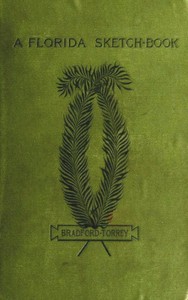
The catalog record for A Florida Sketch-Book — A Reader’s Guide provides practical reading context through 51,944 words, 3 hr 46 min estimated reading time, and 7 detected text sections.
The text analysis averages about 20.8 words per sentence, while the detected sections provide another way to judge how the source is divided.
Project Gutenberg metadata also associates the work with “Florida -- Description and travel,” connecting these edition facts with the source record’s subject description.
Explore this collection
These alternatives are selected using recorded categories and estimated reading time.
About 227 minutes
Geography
52,119 recorded words. 1 minutes difference from this book's estimate.
View Gutenberg source #67960About 216 minutes
Geography
49,678 recorded words. 10 minutes difference from this book's estimate.
View Gutenberg source #62610About 214 minutes
Geography
49,192 recorded words. 12 minutes difference from this book's estimate.
View Gutenberg source #67784Search stored excerpts and compare books → Choose by your preferences →
Choices use stored catalog measurements. Estimates vary with reading speed. A shared category is a catalog label, not a claim that two books have the same argument or literary quality.
Search reads excerpt text stored with this catalog and links to its associated Gutenberg record. The connection is stored in the site database; this tool does not recheck that every excerpt is word-for-word identical to that external record. Excerpt search does not cover every chapter and does not verify historical publication dates.
Catalog snapshot checked: 2026-09-25. Coverage: 97 public books, 97 available source excerpts.
Calculated from edition completeness, EPUB availability, text structure and catalogue metadata. Not a user rating.
Total of 100 points, scaled to a 2.5-5.0 range. Editions with an empty description or a missing EPUB file are not scored.
Public-domain source text
The source text is kept in the dedicated reader, separate from this catalogue record and its commentary.
Bradford Torrey's A Florida Sketch-Book (1894) opens with a traveler's weariness at the seemingly endless pine barrens near Jacksonville, yet the author immediately confesses an eagerness to explore them. The catalog subjects—Florida description and travel, birds—are present, but the excerpts show a more complicated relationship: Torrey's attention to birds is constant, but his primary interest is the experience of place, often uneasy. He describes the flat-woods as "poverty-stricken and God-forsaken" yet admits he was "impatient to get into them." This tension between repulsion and attraction drives the sketches. The bird observations, while numerous, are woven into a larger narrative of sensory immersion—the sound of a grackle flock, the sight of a fish-hawk—rather than serving as a systematic field guide.
Torrey's Florida is not a sunny paradise but a place of "perpetual alternation" between arid wastes and stagnant water. In the flat-woods, he struggles to enter the woods themselves: "As I advanced, they receded." The landscape resists easy access, and the author's frustration is palpable. Later, in a cypress swamp, the scene becomes almost gothic: "green water full of slimy black roots and branches," with buzzards that seem to say, "the fever will do its work." Torrey's descriptions are precise and sensory, but they also convey a psychological state—a mix of curiosity, dread, and fascination. The swamp "had me under its spell," he writes, and he must force himself to leave. This is not a travelogue of scenic wonders but a record of how a place can unsettle and captivate simultaneously.
Though the catalog lists birds as a subject, Torrey's ornithology is less scientific than atmospheric. He notes a flock of grackles that "made the place loud" and then, after they leave, emphasizes the stillness. A fish-hawk's cry is recalled from the previous day. Swallows over the lake are "wise and happy birds, lovers of sunlight and air"—a contrast to the swamp's gloom. These observations serve as emotional markers rather than data points. The author's interest is in the soundscape and the way birds punctuate the landscape's mood. Even when he encounters a boy with a gun hunting rabbits, the conversation turns to grammar, not natural history. The bird lore is present but subordinated to the human experience of the environment.
Torrey's sketches include brief, telling interactions with residents. A "kindly cracker" warns him against getting lost. A middle-aged negro hoes and sings a "wild, minor, endless kind of tune"—a hymn that Torrey calls "as artless as any bird's." The author walks slowly to hear more, and the singer "minded me not." Later, a boy with a gun corrects his own grammar: "I saw one," not "I seen." Torrey notes approvingly, "Here is a grammarian." These moments are not developed into character studies; they are fleeting, like the bird calls. They add texture to the travel narrative, grounding the landscape in human presence. The boy's persistence about the rabbit and the singer's obliviousness to the listener both suggest a world going about its business, indifferent to the observer.
The table of contents lists eleven sketches, from "In the Flat-Woods" to "Walks about Tallahassee." The excerpts suggest a loose, episodic structure: each chapter is a self-contained visit to a location—a marsh, a beach, a river, a cotton plantation. Torrey moves between places without a continuous narrative arc. The prose is reflective, sometimes humorous, often lyrical. He is as interested in his own reactions as in the scenery. The book's title, A Florida Sketch-Book, is apt: these are impressions, not a comprehensive guide. The reader is invited to dip in and out, following the author's wandering attention.
Torrey's Florida is a place of contradictions: monotonous yet fascinating, malarious yet alluring. Readers should approach these sketches as a naturalist's personal diary rather than a field manual. The bird sightings are there, but they are part of a larger sensory record—of heat, sand, water, and the constant hum of insects and human voices. The book rewards those who enjoy slow, observational prose and who are willing to let the landscape's mood settle over them, as it did over Torrey.
That rainy afternoon, Torrey’s Florida felt less like escape than endurance—the flatwoods’ sameness pressing in, broken only by a warbler’s flicker. I closed the book, restless, and reached for something coastal. His wary wonder lingered, but Cape Coddities — Edition Insights traded the swamp’s menace for salt air. Same patient watching, gentler weather. I stayed there until the rain stopped, somehow homesick for both.
Use these questions to collect your thoughts before moving on.