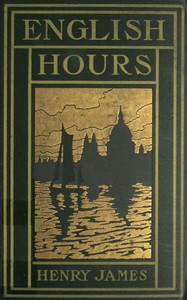
English Hours — Story, Setting & Ideas

  2   0
James, Henry, 1843-1916, Pennell, Joseph, 1857-1926 [Illustrator] Project Gutenberg 2019
England -- Description and travel; James, Henry, 1843-1916 -- Travel -- England Readers of public-domain and historical texts
Project Gutenberg digital edition en

Edition facts

Words: 80,118
Reading time: 349 min
Text sections: 24
Henry James's early impressions of England, revised in 1905, capture the tension between imperial grandeur and domestic squalor, personal sentiment and political critique, through vivid sketches of London, cathedrals, and countryside.
Share

Henry James's English Hours opens not with a panoramic view but with a sentry-box. In the essay on Woolwich, James confesses that even a sentry-box can set him thinking about 'the glory of this little island.' This confession reveals the book's central method: the smallest details—a guardhouse, a cathedral tower, a rainy street—become occasions for extended meditation on England's character, history, and imperial standing. The collection, first published in periodicals and revised for the 1905 edition, spans decades of James's evolving relationship with the country. The author's note admits he has 'sufficiently outlived' the 'fine freshness' of his early wonderments, yet he has 'nowhere scrupled to rewrite a sentence or a passage.' The result is a layered text where early enthusiasm and later skepticism coexist.

The Sentry-Box and the Empire

In the Woolwich essay, James stages a debate between himself and 'Americans who live on the Continent.' These sojourners declare England's 'traditional prestige is completely extinct' and that 'the affairs of Europe will be settled quite independently of her action.' James's reply is personal: 'If the greatness of England were really waning it would be to him as a personal grief.' He wishes England would 'do something—something striking and powerful,' and recalls the Spectator's call to occupy Egypt. But he also quotes Mr. Gladstone's reply—that England must attend to 'local taxation and the liquor-laws'—and finds the phrase 'almost squalid.' The passage captures a tension between imperial nostalgia and the mundane realities of governance. James does not resolve the tension; he lets it vibrate, as he says, 'quite too richly.'

Rewriting Freshness: The 1905 Revisions

James's 1905 note is unusually candid about revision. He describes the essays as representing 'a good many wonderments and judgments and emotions, whether felicities or mistakes, the fine freshness of which the author has—to his misfortune, no doubt—sufficiently outlived.' Yet he adds that he has 'attentively looked them over' and 'nowhere scrupled to rewrite a sentence or a passage on judging it susceptible of a better turn.' This creates a peculiar reading experience: the text is both a record of early impressions and a later artist's refinement. The reader cannot always distinguish the original from the revision. The effect is a palimpsest, where James's mature style overlays his younger observations, making the book a meditation on memory and craft as much as on England.

Illustrations as Companions

James explicitly states that the essays are 'here once more placed together, for the great advantage they will be felt to derive from the company and support of Mr. Pennell's illustrations.' Joseph Pennell's drawings—of Magdalen Tower, the Gate-House at Cambridge, St. Paul's from Ludgate Hill—are not mere decorations. They anchor James's verbal impressions in visual specifics. The list of illustrations includes twenty-two plates, from 'Richmond, from the Thames' to 'The Medway and Rochester Keep.' James's prose often describes scenes that Pennell has drawn, creating a dialogue between word and image. The reader is invited to compare the artist's line with the writer's sentence, each offering a different kind of precision. This interplay is part of the book's design, not an afterthought.

Readers approaching English Hours should attend to the dates: each essay is marked with its original publication year, and James's revisions may be detected by comparing early and late passages. The book rewards those who read slowly, letting the sentry-boxes and cathedral towers accumulate into a complex portrait of a nation seen through a foreigner's evolving eyes. The illustrations by Joseph Pennell are integral, not supplementary; consider them as you read.

Related eBooks