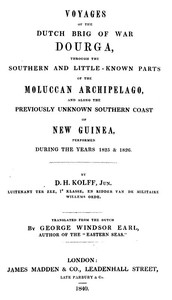
D. H. Kolff, a Dutch naval lieutenant, opens his narrative with a plain-spoken preface that sets the tone for the entire work: he is a seaman, not a literary man, and offers an 'unadorned narrative' of his voyages. The translation by George Windsor Earl preserves this directness, allowing the reader to encounter the text as a factual report rather than a polished travelogue. The author's voice emerges through specific details—the naming of trees like kanari and katapan laut, the description of a village square, and the precise account of a teacher's three-cornered hat and black stockings. These concrete observations ground the narrative in the physical world of the Moluccan Archipelago.
A Seaman's Self-Effacing Voice
Kolff repeatedly downplays his literary ambitions, calling his work a 'simple narrative' and a 'plain preface.' This modesty is not mere convention; it shapes the prose. He describes his health as 'undermined and broken' by fatigue, yet he pushes forward, driven by duty. The reader senses a man who values accuracy over elegance. When he notes that the ground is 'by no means fertile' and that the inhabitants 'would cut a road' if more industrious, he offers blunt assessments without moralizing. His voice is that of a practical officer, more comfortable with charts than with flourishes.
Ethnographic Detail Through the Officer's Eye
Kolff's descriptions of native life are precise and unromantic. At Duryella, he notes the village's square layout, the fortification on a high tree, and the Orang Kaya's house on 'high piles of iron-wood.' He observes the Amboynese teachers with their 'three-cornered hat, a black coat of cloth or cotton, small-clothes of the same materials, with shoes, and black silk or cotton stockings.' This attention to dress and social structure reveals a colonial administrator's interest in order and hierarchy. He also records the teachers' precarious finances, noting that they depend on the natives for support and are 'in very necessitous circumstances.' Such details offer a window into the practical challenges of Dutch influence in the region.
The Landscape as a Catalogue of Useful Plants
Kolff's eye for botany is evident in his enumeration of trees along the shore: kanari, katapan laut, tutun, yamplon, casuarina, and bua-raja. He notes that the fruit of the last, when dried and pounded, 'is often used instead of flour in the composition of pastry.' This practical knowledge reflects the expedition's purpose: to gather information useful for navigation, trade, and settlement. The landscape is not picturesque but functional—a source of food, timber, and potential roads. Even the sago trees are mentioned primarily as 'the chief food of the natives.' Kolff's descriptions serve a utilitarian purpose, aligning with his role as a naval explorer.
The Translator's Invisible Hand
George Windsor Earl, himself an author of The Eastern Seas, translates Kolff's Dutch into English that retains a slightly formal, nineteenth-century naval tone. The syntax is straightforward, with occasional inversions ('If the inhabitants were rather more industrious they would cut a road'). Earl likely smoothed some rough edges, but the voice remains Kolff's: a man who reports what he sees without embellishment. The translation includes Dutch terms like Orang Kaya and lelahs, preserving local color. Readers should note that the text is a mediated account—Earl's choices in vocabulary and sentence structure shape our perception of Kolff's observations.
Kolff's narrative rewards readers who attend to small details: the color of a teacher's stockings, the shape of a village, the names of trees. These specifics, rather than grand themes, give the work its texture. The author's modesty and his translator's restraint combine to produce a document that feels unvarnished. Approach it as a primary source for the material culture and colonial administration of the Moluccas in the 1820s, and you will find a wealth of precise, unadorned observation.
Reading Kolff's plain-spoken log of the Dourga, I remembered a quiet afternoon in my grandmother's sitting room. She owned a copy of The Flowers and Gardens of Madeira — Edition Insights, and its careful, unhurried descriptions of terraced blooms felt much like this—a steady hand recording what it saw, without needing to convince anyone. Both left me with that same gentle ache for places I've never visited.