About 576 minutes
Seven years in South Africa, volume 2 (of 2) — Key Ideas to Explore
Geography
132,464 recorded words. 0 minutes difference from this book's estimate.
View Gutenberg source #74291
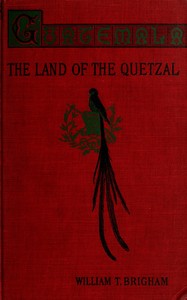
The catalog record for Guatemala — Text and Context provides practical reading context through 132,457 words, 9 hr 36 min estimated reading time, and 28 detected text sections.
The text analysis averages about 20.5 words per sentence, while the detected sections provide another way to judge how the source is divided.
Project Gutenberg metadata also associates the work with “Guatemala -- Description and travel,” connecting these edition facts with the source record’s subject description.
Explore this collection
These alternatives are selected using recorded categories and estimated reading time.
About 576 minutes
Geography
132,464 recorded words. 0 minutes difference from this book's estimate.
View Gutenberg source #74291About 550 minutes
Geography
126,427 recorded words. 26 minutes difference from this book's estimate.
View Gutenberg source #67903About 617 minutes
Geography
141,883 recorded words. 41 minutes difference from this book's estimate.
View Gutenberg source #69657Search stored excerpts and compare books → Choose by your preferences →
Choices use stored catalog measurements. Estimates vary with reading speed. A shared category is a catalog label, not a claim that two books have the same argument or literary quality.
Search reads excerpt text stored with this catalog and links to its associated Gutenberg record. The connection is stored in the site database; this tool does not recheck that every excerpt is word-for-word identical to that external record. Excerpt search does not cover every chapter and does not verify historical publication dates.
Catalog snapshot checked: 2026-09-25. Coverage: 97 public books, 97 available source excerpts.
Calculated from edition completeness, EPUB availability, text structure and catalogue metadata. Not a user rating.
Total of 100 points, scaled to a 2.5-5.0 range. Editions with an empty description or a missing EPUB file are not scored.
Public-domain source text
The source text is kept in the dedicated reader, separate from this catalogue record and its commentary.
William T. Brigham’s Guatemala: the land of the quetzal; a sketch (1887) moves between three modes: a traveller’s practical handbook, a naturalist’s descriptive catalogue, and a historian’s reconstruction of indigenous kingdoms. The preface frames the work as a remedy for the author’s own lack of guidance, yet the book quickly exceeds that modest aim. Brigham juxtaposes sweeping landscape comparisons—valleys like Pacific islands, uplands like Indian Neilgherries—with precise observations of local costume, climate, and commerce. The structure alternates between regional surveys and extended historical narratives, notably the Quiché-Cakchiquel wars, drawn from native chronicles. This editorial note focuses on how Brigham organises his material, the recurring image of the land as a stage for conflict, and the shifts between panoramic description and close-up detail.
Brigham explicitly disclaims any intention to produce a monograph. The subtitle calls the work “a sketch,” and the preface insists it is merely collected notes from three journeys. Yet the book’s organisation belies this modesty. It opens with a geographical overview, then moves through departments and towns, interspersing chapters on antiquities, indigenous history, and practical advice. The effect is a layered portrait: the reader sees Guatemala through a traveller’s sequential experience, but also through a naturalist’s taxonomic eye. Brigham’s voice shifts accordingly—sometimes the weary traveller noting “rough places,” sometimes the antiquarian quoting the Cakchiquel Chronicle. This hybrid structure allows him to move from the general to the particular without settling into a single genre.
Brigham repeatedly describes Guatemalan scenery by invoking far-flung analogues: valleys like Pacific islands, uplands like Indian Neilgherries, forests like Brazil, lakes like Switzerland, green slopes like Ireland, glens like the Trossachs, deserts like the Sahara, volcanoes like Ætna. This rhetorical device does more than convey variety; it positions Guatemala as a microcosm of global geography. The comparisons are not merely decorative—they reflect Brigham’s training as a naturalist and his desire to make the unfamiliar legible to an American audience. Yet the very profusion of analogues hints at a deeper anxiety: the landscape resists easy summary. Each new region demands a new comparison, and the catalogue never quite coheres into a single picture.
One of the longest continuous passages in the excerpts recounts the war between the Quichés and Cakchiquels, drawn from the Cakchiquel Chronicle. Brigham inserts this narrative almost as a set-piece, complete with quoted battle description: “the war-cries were heard, standards were unfurled, drums and conchs resounded.” The passage is remarkable for its detail—named kings, captured gods, lists of prisoners—and for its shift in register from descriptive travelogue to epic history. Structurally, this section anchors the book’s treatment of indigenous societies. Brigham does not treat native peoples as static relics; he gives them a dynamic political history, complete with alliances, betrayals, and military tactics. The narrative also introduces a recurring motif: the land as a site of conflict, where mountains and rivers become stages for dynastic struggle.
Brigham’s prose constantly shifts scale. A paragraph may begin with a broad climatic claim—“No country on the northern half of the American continent has a finer climate”—then narrow to a specific valley or town. In the historical sections, the focus zooms from the fate of entire kingdoms to the actions of individual kings and priests. This movement is not random; it follows the logic of the traveller’s eye, which scans the horizon and then fixes on a detail. Brigham also uses this technique to manage the book’s length (over 130,000 words). By alternating panorama with close-up, he sustains momentum across 28 sections. The reader is never allowed to settle into a single mode for long, and the constant reframing keeps the unfamiliar terrain fresh.
Brigham’s Guatemala rewards readers who attend to its structure as much as its content. The book is best approached not as a systematic geography but as a traveller’s composite sketch, where each chapter adds a new layer of observation. Pay attention to the shifts in scale—from mountain ranges to market towns, from dynastic wars to road conditions—and to the recurring comparisons that tie Guatemala to a wider world. The historical sections, though incomplete, offer a rare glimpse into indigenous sources. For those interested in the interplay of travel writing, natural history, and early ethnography, this text is a valuable document of late-nineteenth-century Central American exploration.
Reading Brigham’s book felt like sitting with someone who had folded entire countries into a single notebook, the dirt still clinging to his pages. I thought of that quiet patience again when I stumbled upon The Murray River Being a Journal of the Voyage of the "Lady Augusta" Steamer from the Goolwa, in South Australia, to Gannewarra, above Swan Hill, Victoria, a Distance from — A Reader’s Guide, another journey recorded simply because the water was there.
Answer a few questions and save a private reflection on this device.