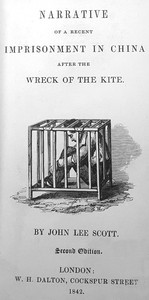
John Lee Scott's Narrative of a Recent Imprisonment in China after the Wreck of the Kite (1842) opens with a preface in which the author, a young merchant sailor, explains that he wrote the account for friends and was urged to publish. The catalog subjects—China description and travel, social life and customs, and prisoners of war—are all present, but the excerpts reveal a text that is less a systematic survey than a personal chronicle of captivity. Scott's voice is direct and unadorned, focusing on concrete details: the weight of irons, the distribution of clothing, the layout of rooms. The narrative does not attempt to explain Chinese society broadly; instead, it records what Scott saw and experienced, filtered through his own limited perspective as a prisoner.
Captivity and the Limits of Observation
The excerpts show Scott describing his surroundings with a sailor's eye for physical detail rather than ethnographic analysis. When he enters a mandarin's compound, he notes the canopy of red and green silk, the ornamental garden with rocks but few flowers, and the glazed arm-chairs and paper lanterns in the reception chamber. These observations are precise but remain at the surface; Scott does not speculate on the meaning of the arrangements. His account of the interrogation scene—the bowing, tea-drinking, and reading of letters—is similarly factual. The catalog subject 'China—Social life and customs' is thus addressed only insofar as Scott records what he sees, without interpretation. This limitation is a feature of the narrative: it offers a prisoner's-eye view, not a guidebook.
The Mandarins' Ambiguous Kindness
A striking episode in the excerpts involves the mandarins providing winter clothing to the prisoners. Scott initially doubts their promise of release in six days, noting that 'this anxiety to provide us with clothing for the cold weather, made me doubt very much whether six days, or even six weeks, would find us on our way to Chusan.' His suspicion proves correct: the group is held for sixteen more weeks. The mandarins' actions—distributing dungaree coats and leggings, removing irons—are presented as both practical kindness and a signal of prolonged detention. Scott does not resolve this ambiguity, leaving readers to weigh the mandarins' motives. The episode illustrates how the narrative resists simple categorization of captors as either cruel or benevolent, instead recording mixed signals.
Selective Relief and Unequal Suffering
When supplies arrive from Chusan, Scott notes a telling disparity: letters and clothing come for Lieutenant Douglas, Captain Anstruther, and Mrs. Noble, but 'nothing whatever arrived for the crew.' Scott, as a young sailor, is part of the crew, and his matter-of-fact recording of this inequality underscores the social hierarchy among the prisoners. The mandarins' subsequent distribution of clothing to all, including the crew, partially addresses the lack, but the initial neglect from their own side is left unremarked. The catalog subject 'Prisoners of war' is thus nuanced by class distinctions within the captive group. Scott's narrative does not dwell on this injustice, but the detail speaks for itself, revealing the layered experiences of captivity.
Readers approaching this narrative should attend to what Scott chooses to record and what he omits. His account is strongest in its concrete, unadorned descriptions of daily life under guard—the rooms, the food, the removal of irons. It is weaker in explaining the broader context of the First Opium War, which is barely mentioned. The catalog subjects provide a useful starting point, but the text itself is a personal document, not a comprehensive survey. Treat it as a primary source that captures one sailor's experience, with all the gaps and biases that entails.
Reading about John Lee Scott's long days under watch in China, I kept thinking how a place becomes a kind of memory you carry, not a destination. The way he noticed small routines and faces stayed with me. That same quiet layering of observation lives in the Grand moving diorama of Hindostan — A Reader’s Guide, where looking slowly turns into something closer to knowing. Both left me a little quieter.