About 122 minutes
Cape Cod is a number of things — Themes and Context
Geography
28,053 recorded words. 0 minutes difference from this book's estimate.
View Gutenberg source #74413
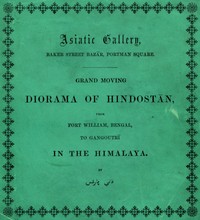
This digital edition of Grand moving diorama of Hindostan — A Reader’s Guide is described by source-level measurements including 28,000 words, 2 hr 2 min estimated reading time, and 7 detected text sections.
The text analysis averages about 27.6 words per sentence, while the detected sections provide another way to judge how the source is divided.
Project Gutenberg metadata also associates the work with “India -- Description and travel,” connecting these edition facts with the source record’s subject description.
Explore this collection
These alternatives are selected using recorded categories and estimated reading time.
About 122 minutes
Geography
28,053 recorded words. 0 minutes difference from this book's estimate.
View Gutenberg source #74413About 125 minutes
Geography
28,728 recorded words. 3 minutes difference from this book's estimate.
View Gutenberg source #73368About 116 minutes
Geography
26,630 recorded words. 6 minutes difference from this book's estimate.
View Gutenberg source #57437Search stored excerpts and compare books → Choose by your preferences →
Choices use stored catalog measurements. Estimates vary with reading speed. A shared category is a catalog label, not a claim that two books have the same argument or literary quality.
Search reads excerpt text stored with this catalog and links to its associated Gutenberg record. The connection is stored in the site database; this tool does not recheck that every excerpt is word-for-word identical to that external record. Excerpt search does not cover every chapter and does not verify historical publication dates.
Catalog snapshot checked: 2026-09-25. Coverage: 97 public books, 97 available source excerpts.
Calculated from edition completeness, EPUB availability, text structure and catalogue metadata. Not a user rating.
Total of 100 points, scaled to a 2.5-5.0 range. Editions with an empty description or a missing EPUB file are not scored.
Public-domain source text
The source text is kept in the dedicated reader, separate from this catalogue record and its commentary.
The catalog subjects for this work—'India -- Description and travel' and 'Panoramas -- England -- London -- History -- 19th century'—suggest a straightforward pairing of travelogue and exhibition history. Yet the text of the Grand moving diorama of Hindostan is neither a traveler's diary nor a technical account of panorama construction. It is a guidebook to a painted diorama, but one that repeatedly abandons the frame of the exhibition to deliver detailed, on-site descriptions of Indian architecture, religious practice, and colonial infrastructure. The tension between what the catalog promises and what the excerpts deliver is instructive: the work is less about the diorama as a medium and more about the diorama as a pretext for a densely annotated virtual tour.
The catalog subject 'Panoramas -- England -- London -- History -- 19th century' implies a focus on the exhibition itself. But the excerpts devote far more space to the buildings depicted than to the mechanics of their display. The description of the minarets at Madhoray Ghāt, for instance, gives precise measurements—'eight and a half feet in diameter at the base' and 'an altitude of 147 feet 2 inches'—and recounts repairs by James Prinsep, including the fact that the minarets 'incline outwards fifteen inches from the perpendicular.' This is architectural reportage, not exhibition commentary. Similarly, the account of Ghoosla Ghāt praises its 'great solidity with a graceful and appropriate elevation' and notes how the river 'rises above the top of the doorway, entering the staircase.' The diorama is merely the occasion; the text functions as a gazetteer.
The catalog subject 'India -- Description and travel' is more apt, but the excerpts reveal a particular mode of description: one that mixes ethnographic observation with colonial administration. At Rajrajeswurree Ghāt, the text notes a 'Baniyā, or grain merchant' selling 'chabenī, the parched grain of Indian corn (maize), also flour for their chappatīs.' Pilgrims are described in passing. More strikingly, the account of the minarets includes a series of suicides and a miraculous survival: a Fakīr who fell 'through the tiles and mat-work of a roof, scraping the flesh from his sides' and then 'disappeared immediately on recovering from his bruises, and sundry solid moveables of his host disappeared with him.' The tone is detached, almost anecdotal. The text also draws explicit parallels between Hindu practices and Scripture, as when it links pouring water to the sun and moon to 'a passage in Scripture, “To pour out drink-offerings to the queen of heaven.” (Jer. xliv. 17.)' This is description shaped by an evangelical and administrative gaze.
The 'List of Plates' at the beginning of the text offers a clearer picture of the work's structure than the catalog subjects do. The twelve plates move from 'Fort William, Bengal' to 'Gangoutrī' in the Himalayas, following the course of the Hoogly, Bhagirathi, and Ganges rivers. But the list also includes plates with narrative or thematic titles: 'The Fakīr,' 'The Elephant Establishment,' 'The Foolish Fakīr,' 'The Satī.' These suggest that the diorama—and by extension the guidebook—interleaves scenic views with set-piece scenes of Indian life, often with a moralizing or sensational bent. The catalog subject 'Panoramas' might lead a reader to expect a continuous visual sweep; the plate list indicates a series of discrete, curated tableaux. The text thus mediates between the immersive promise of the diorama and the episodic, annotated format of a travel book.
Readers approaching this work through its catalog subjects should be prepared for a text that is more encyclopedic than its exhibitionary framing suggests. The diorama is a device, but the real interest lies in the density of architectural, ethnographic, and historical annotation. The excerpts do not reveal whether the guidebook was sold at the exhibition or read independently, but they make clear that the work is best understood as a hybrid: part souvenir, part gazetteer, part colonial archive.
Leafing through the diorama guide, I felt the odd tenderness of a spectacle long gone, its grand claims now hushed. It reminded me, quietly, of holding London — A Reader’s Guide—not for any similarity of subject, but because both books carry that faint, lovely ache of a city being arranged for someone else's gaze, a memory I half-share.
A brief reflection can help important ideas stay with you longer.