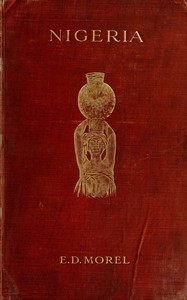
Morel opens his study with a formal preface acknowledging debts to newspaper editors, colonial officials, and Nigerian merchants, as well as a public address from the Native Community of Lagos. This establishes the book as a work of firsthand observation and political advocacy, grounded in the author's 1911 journey. The frontispiece—a photograph of a Borgu canoe-man—signals an interest in the human landscape of the Niger region.
The preface also dedicates the book to Mary Kingsley, the travel writer who championed understanding African societies on their own terms. Morel's tone is courteous and earnest, positioning himself as a sympathetic but critical observer of British colonial rule. The reader is thus prepared for a text that will blend travel narrative, ethnographic description, and policy argument.
A Preface of Acknowledgments and Purpose
The preface reveals Morel's network: he thanks the Times and Manchester Guardian for permission to reprint articles, and names colonial governors, railway engineers, and merchants who facilitated his travels. Notably, he acknowledges the Native Community of Lagos—Christian, Mohammedan, and Pagan—for a cordial public reception and an address. This detail suggests that Morel sought engagement with educated Africans, not only European officials.
He also thanks Messrs. John Holt & Co. for placing steamers at his disposal, and the British Cotton Growing Association. The list of acknowledgments reads like a roll call of colonial stakeholders: government, commerce, and mission. Yet the dedication to Mary Kingsley hints at a counter-current: Kingsley had argued for preserving African institutions. Morel's preface thus frames the book as both a product of official access and a critique of colonial orthodoxy.
The Land Question as a Central Argument
In the later excerpt, Morel devotes sustained attention to the Land and Native Rights Proclamation of 1910 for Northern Nigeria. He calls it “the most far-seeing measure of constructive statesmanship West Africa has ever known.” The proclamation, he explains, codifies three principles: all land is native land; the Governor holds it for the natives' common benefit; and his power must follow native laws and customs.
Morel argues that this is not land nationalization but “communalizing of the communal value,” leaving the occupier full control over use and private profit. He contrasts it with English law, which he calls “crude, ignorant and unscientific.” The passage is dense with policy detail and moral urgency. Morel warns that without such legislation, European speculators would create a landlord class and break up the native system. The reader sees the book's core thesis: that good colonial governance means adapting to, not overriding, indigenous structures.
Travel, Observation, and the Human Landscape
Though the excerpts do not include extended travel narrative, the frontispiece and preface imply a journey up the Niger. Morel mentions a camera accident and thanks those who supplied photographs, indicating that visual documentation was part of his method. The book's title—Nigeria: Its Peoples and Its Problems—promises a dual focus: ethnographic description and policy analysis.
The preface's acknowledgment of “Mohammedan Chiefs representing many different tribes of the hinterland” who gathered under Dr. Blyden's roof in Sierra Leone suggests that Morel sought out African informants beyond the coast. The reader should expect chapters that move between descriptive accounts of peoples—their customs, economies, and political structures—and arguments about how colonial rule should engage with them. The land proclamation excerpt shows that Morel's travel observations underpin his policy prescriptions.
The Rhetoric of Reform and Warning
Morel's prose in the land section is forceful and declarative. He writes that “things move slowly in West Africa” and that “West Africa's problems had never been thought out ahead before.” He praises the Colonial Office for sanctioning the proclamation but warns that its principles must be “watched strictly” and applied to Southern Nigeria. The tone is that of an insider pressing for reform, not a neutral observer.
He uses contrast: the proclamation is “conservative” not “innovating,” a “preservation of the status quo.” This rhetorical move defends the measure against charges of radicalism. Morel also employs economic reasoning: the land law will generate a healthy land revenue and prevent speculative holding. The reader should note how Morel blends moral argument with practical calculation. His voice is that of a public intellectual who believes that right policy and good governance are inseparable.
Morel's book is best approached as a work of engaged colonial criticism, not a neutral survey. The excerpts show a writer who moves between travel observation and policy argument, always with an eye to the human consequences of administration. Readers interested in the history of colonial land law, the intellectual legacy of Mary Kingsley, or early twentieth-century debates about indirect rule will find this a rich primary source. The book rewards attention to its rhetorical strategies as much as its factual content.
I keep returning to Morel’s paragraphs on Nigerian land stewardship, how carefully he weighed native custom against colonial rule. It stirred a memory of another dusty volume, Through deserts and oases of central Asia — Context and Discussion, where the same quiet patience with unfamiliar places seemed to linger. Both feel less like reports, more like letters home.