About 290 minutes
Venice — Story, Setting & Ideas
Geography
66,589 recorded words. 3 minutes difference from this book's estimate.
View Gutenberg source #66295
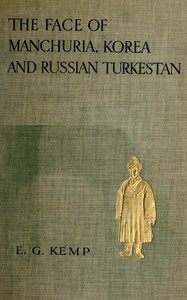
This digital edition of The face of Manchuria, Korea, & Russian Turkestan — Reading Companion is described by source-level measurements including 65,854 words, 4 hr 47 min estimated reading time, and 27 detected text sections.
The text analysis averages about 28.0 words per sentence, while the detected sections provide another way to judge how the source is divided.
Project Gutenberg metadata also associates the work with “Korea -- Description and travel,” connecting these edition facts with the source record’s subject description.
Explore this collection
These alternatives are selected using recorded categories and estimated reading time.
About 290 minutes
Geography
66,589 recorded words. 3 minutes difference from this book's estimate.
View Gutenberg source #66295About 282 minutes
Geography
64,745 recorded words. 5 minutes difference from this book's estimate.
View Gutenberg source #76702About 272 minutes
Geography
62,510 recorded words. 15 minutes difference from this book's estimate.
View Gutenberg source #58230Search stored excerpts and compare books → Choose by your preferences →
Choices use stored catalog measurements. Estimates vary with reading speed. A shared category is a catalog label, not a claim that two books have the same argument or literary quality.
Search reads excerpt text stored with this catalog and links to its associated Gutenberg record. The connection is stored in the site database; this tool does not recheck that every excerpt is word-for-word identical to that external record. Excerpt search does not cover every chapter and does not verify historical publication dates.
Catalog snapshot checked: 2026-09-25. Coverage: 97 public books, 97 available source excerpts.
Calculated from edition completeness, EPUB availability, text structure and catalogue metadata. Not a user rating.
Total of 100 points, scaled to a 2.5-5.0 range. Editions with an empty description or a missing EPUB file are not scored.
Public-domain source text
The source text is kept in the dedicated reader, separate from this catalogue record and its commentary.
Kemp begins her narrative not at the start of her journey but at the moment she crosses into Manchuria, a deliberate structural choice to avoid repetition of well-trodden Trans-Siberian descriptions. This decision frames the book as a focused, ground-level account of regions in flux. The preface reveals her motivation: existing travel books were already outdated, and she sought to capture the present reality—especially the quiet encroachment of Russia and Japan. Her method is observational, blending pen and brush, and the text moves through a series of vignettes rather than a chronological log.
Kemp’s narrative structure is defined by border crossings and the movement between territories. She begins her tale from the Manchurian border, skipping the familiar Trans-Siberian route to give “more continuity.” This choice creates a sense of immediacy and purpose. The journey is not a simple itinerary but a series of transitions: from the brown hill-sides of Korea to the valleys of Manchuria, from the presence of Japanese protection to the remnants of Russian influence. Each shift in location brings a new set of observations—on landscape, infrastructure, and the people encountered. The text is organized into 27 sections, likely corresponding to stages of travel, but Kemp avoids rigid chapter breaks, preferring a flowing account that mirrors the continuous movement of the traveler.
Certain images recur throughout the excerpts, creating a visual rhythm. The landscape is repeatedly described in terms of brown: “brown hill-sides,” “brown earth and stubble thick with rime.” This palette suggests late winter or early spring, a season of transition. Pheasants appear as a motif—calling, trotting away, and later mentioned as potentially poisoned. They serve as markers of the environment and of human presence, as their behavior changes under Japanese protection. The rime and stubble reinforce a sense of cold and dormancy, while the pheasants inject life and movement. Kemp’s eye for such details gives the travelogue a painterly quality, consistent with her stated aim to describe by “pen and brush.”
Kemp’s narrative is punctuated by encounters with local people, which serve as structural anchors for her observations. In one extended passage, she describes a young mother with a baby who shows her a Testament and hymn book, leading to a scene of family worship at an inn. The encounter is rendered with specific details: the English hand-shake, the new-laid eggs, the singing of hymns. These moments break the travelogue’s descriptive passages and provide human warmth. Kemp is careful to note what she cannot know—the meaning of the Korean hymns—and limits inference. The encounters also reveal social conditions: the lack of education in country districts, the prevalence of pedlars carrying “superior sheeting K K K,” and the rarity of Western travelers.
The journey is characterized by constant movement through narrow valleys and over ridges, with Kemp noting how “large a part of the country is uninhabited.” The road winds, and the hill-sides are used only for cemeteries and firewood. This spatial awareness creates a sense of emptiness and isolation, punctuated by occasional signs of life: a falconer, a ricksha with a Westerner, a school (only one in eight days). The movement is not just physical but temporal—the text shifts from the present of 1910 to the recent past of the Russo-Japanese War, as when Kemp quotes Whigham’s 1904 prediction that Japan would never invade Manchuria. This layering of time adds depth to the travelogue, showing how quickly political realities have changed.
Kemp’s account is best read as a series of impressions rather than a systematic survey. The reader should attend to the small details—the rime on stubble, the handshake of a Korean girl, the pedlars’ wares—as they accumulate into a portrait of a region in transition. The narrative’s structure, moving from border to border, mirrors the geopolitical shifts Kemp sought to document. Her limitations are clear: she cannot speak Korean, and her observations are those of a Western traveler. But within those bounds, she offers a vivid, ground-level view of Manchuria, Korea, and Russian Turkestan in 1910.
That rainy afternoon, Kemp’s dust and train-whistles felt closer than the windowpane. His constant measuring of distance—how far a road, a river, a war had carried him—left me restless. I wanted water, but flowing slow. So I found The Murray River Being a Journal of the Voyage of the "Lady Augusta" Steamer from the Goolwa, in South Australia, to Gannewarra, above Swan Hill, Victoria, a Distance from — A Reader’s Guide. A different kind of travel—measured by bends, not borders.
Save your reaction, strongest insight, and memorable passage.