About 151 minutes
The Passing of Morocco — Text and Context
Geography
34,630 recorded words. 4 minutes difference from this book's estimate.
View Gutenberg source #66521
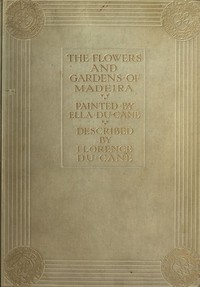
The source record for The Flowers and Gardens of Madeira — Edition Insights measures this digital text at 35,529 words, 2 hr 35 min estimated reading time, and 18 detected text sections.
The text analysis averages about 33.5 words per sentence, while the detected sections provide another way to judge how the source is divided.
Project Gutenberg metadata also associates the work with “Flowers -- Madeira Islands -- Madeira,” connecting these edition facts with the source record’s subject description.
Explore this collection
These alternatives are selected using recorded categories and estimated reading time.
About 151 minutes
Geography
34,630 recorded words. 4 minutes difference from this book's estimate.
View Gutenberg source #66521About 164 minutes
Geography
37,651 recorded words. 9 minutes difference from this book's estimate.
View Gutenberg source #12518About 141 minutes
Geography
32,363 recorded words. 14 minutes difference from this book's estimate.
View Gutenberg source #67710Search stored excerpts and compare books → Choose by your preferences →
Choices use stored catalog measurements. Estimates vary with reading speed. A shared category is a catalog label, not a claim that two books have the same argument or literary quality.
Search reads excerpt text stored with this catalog and links to its associated Gutenberg record. The connection is stored in the site database; this tool does not recheck that every excerpt is word-for-word identical to that external record. Excerpt search does not cover every chapter and does not verify historical publication dates.
Catalog snapshot checked: 2026-09-25. Coverage: 97 public books, 97 available source excerpts.
Calculated from edition completeness, EPUB availability, text structure and catalogue metadata. Not a user rating.
Total of 100 points, scaled to a 2.5-5.0 range. Editions with an empty description or a missing EPUB file are not scored.
Public-domain source text
The source text is kept in the dedicated reader, separate from this catalogue record and its commentary.
Florence du Cane opens The Flowers and Gardens of Madeira by confessing her own preconception of the island as a damp, ferny place, only to discover a landscape shaped by centuries of human intervention. The book, illustrated by her sister Ella du Cane, is neither a dry botanical catalogue nor a simple travelogue. Instead, it weaves together descriptions of private gardens, roadside vegetation, and the practical uses of plants—broom for firing, pines for trellises—with a quiet awareness of ecological change. Du Cane’s voice is precise and unhurried, attentive to the way a hillside shifts from ferns to heath as altitude increases.
The introduction establishes a pattern of expectation and correction. Du Cane admits she had imagined Madeira as a place of “luxuriant vegetation flourishing in a damp, enervating climate,” but the reality is more complex. The primeval forests were burned by early settlers—a fire that raged for over two years, according to old historians. What remains is a managed landscape: pine plantations replace chestnut woods, broom is sown on mountain-sides to be cut for fuel or burned to fertilize the ground. Du Cane notes that the broom, though introduced, has become “perfectly naturalized” over 150 years. This tension between the natural and the utilitarian runs through the book. She does not moralize, but her observations accumulate: the destruction of myrtles for church decorations, the threat to water-sources from deforestation. The voice is that of a careful witness, not a polemicist.
Du Cane’s narrative pace mirrors the physical ascent. In the lower altitudes, sentences are longer, filled with lists of plants—Fuchsia coccinea, Rosa Benghalensis, belladonnas—and the scent of fir woods in the morning dew. As the road climbs toward 4,500 feet, the prose becomes sparser, matching the thinning vegetation. Ferns vanish, foxgloves disappear, myrtles become scarce. By the higher slopes, the text is dominated by basalt and red tufa, with only “large bushes of a heath” (likely Erica scoparia) breaking the turf. Du Cane describes these heath bushes as “distorted and stunted” from being eaten by sheep and goats, yet they eventually attain large size, “suggestive of the dwarfed trees of the Japanese.” The shift from abundance to austerity is handled with a quiet, almost geological patience.
Throughout the excerpts, du Cane pays close attention to how people shape the landscape. The broom is not just a plant but a crop: its twigs are made into faggots, its peeled twigs into the “very fine and delicate basket-work peculiar to Madeira.” Young girls and children carry bundles of giesta into town from great distances, earning a “scanty and hard-earned living.” The pine woods are “strictly utilitarian,” planted for rapid growth and cut down for firewood and trellises. Even the beauty of the gardens is tied to human labor and choice. Du Cane’s descriptions of villa gardens—Azaleas, Daturas, Bougainvillea—are set against this backdrop of economic necessity. The book does not separate the ornamental from the practical; both are part of the same island story.
Du Cane’s prose rewards a slow reading. Pay attention to the verbs of change—vanish, replace, become scarce—and to the way she lets the landscape dictate the rhythm of her sentences. The illustrations by Ella du Cane, listed in the front matter, offer a visual counterpart to this verbal precision. Together, text and image create a record of a place in transition, where every flower has a history of use and every garden is a negotiation between nature and human need.
I keep thinking about du Cane’s gentle way of watching a slope change—how a garden fades into wild hillside without apology. English Hours — Story, Setting & Ideas has that same quiet patience, that careful noticing of place over time. It stayed with me like a long afternoon light, soft and unhurried.
Build a private reading journal entry for this title.