About 432 minutes
Cairo to Kisumu — Background and Themes
Geography
99,194 recorded words. 0 minutes difference from this book's estimate.
View Gutenberg source #71651
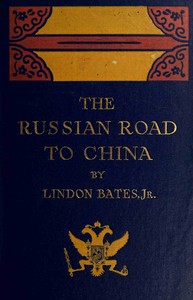
For The Russian road to China — Context and Discussion, the stored edition analysis reports 99,199 words, 7 hr 12 min estimated reading time, and 19 detected text sections.
The text analysis averages about 18.8 words per sentence, while the detected sections provide another way to judge how the source is divided.
Project Gutenberg metadata also associates the work with “China -- Description and travel,” connecting these edition facts with the source record’s subject description.
Explore this collection
These alternatives are selected using recorded categories and estimated reading time.
About 432 minutes
Geography
99,194 recorded words. 0 minutes difference from this book's estimate.
View Gutenberg source #71651About 436 minutes
Geography
100,233 recorded words. 4 minutes difference from this book's estimate.
View Gutenberg source #73902About 439 minutes
Geography
100,896 recorded words. 7 minutes difference from this book's estimate.
View Gutenberg source #72916Search stored excerpts and compare books → Choose by your preferences →
Choices use stored catalog measurements. Estimates vary with reading speed. A shared category is a catalog label, not a claim that two books have the same argument or literary quality.
Search reads excerpt text stored with this catalog and links to its associated Gutenberg record. The connection is stored in the site database; this tool does not recheck that every excerpt is word-for-word identical to that external record. Excerpt search does not cover every chapter and does not verify historical publication dates.
Catalog snapshot checked: 2026-09-25. Coverage: 97 public books, 97 available source excerpts.
Calculated from edition completeness, EPUB availability, text structure and catalogue metadata. Not a user rating.
Total of 100 points, scaled to a 2.5-5.0 range. Editions with an empty description or a missing EPUB file are not scored.
Public-domain source text
The source text is kept in the dedicated reader, separate from this catalogue record and its commentary.
Lindon Bates Jr. opens The Russian Road to China with a description of an ancient way across northern Asia, now harnessed by the steel of the Great Siberian Railroad. His prose moves from the Urals to the steppes, the Altai foothills, and Lake Baikal, then southward along a post-road to Kiahta. Bates’s diction is exact: he notes “cyclopean cuts and tunnels” and the “Trans-Baikal highlands,” grounding the reader in a landscape shaped by both nature and engineering.
In a later excerpt, Bates shifts to an intimate scene inside a Mongol felt hut. Here, his attention to detail reveals a traveler’s self-consciousness: he describes the host’s clean cap, polished chests, and orderly couch, then confesses feeling like a “thrice-dyed barbarian bounder.” This contrast between external observation and internal reflection marks Bates’s narrative voice throughout.
Bates’s word choices often highlight the tension between the foreign observer and the unfamiliar setting. When he enters the lama’s hut, he notes the “prized reserve of milk-chocolate” offered as a peace offering, and the host’s unexpected Russian reply, “Da blagodariou!” The phrase “thrice-dyed barbarian bounder” is striking—it conveys a self-mocking awareness of his own intrusion. Bates does not simply describe; he registers his own discomfort and the host’s composure. The host’s “closely-cropped head” and refusal of a cigarette because he is a priest are details that build character through small actions. Bates’s diction is both precise and evocative: the “fifteen-foot felt hut open at the top” and the “borders of the Gobi Desert” situate the scene geographically while emphasizing its starkness.
Dialogue in the excerpt is sparse but telling. The lama’s “Da blagodariou!” surprises Bates, who had not expected Russian. Alexsimevich, the interpreter, explains: “You speak to a priest, he does not smoke.” This exchange reveals layers of cultural contact—Russian, Mongol, and Buddhist. Bates records the lama’s polite refusal and the interpreter’s clarification without embellishment, letting the reader infer the social dynamics. The offer of snuff in a “beautiful porcelain bottle, patterned in flowers” and the subsequent cigarette exchange are rituals of hospitality that Bates renders with an anthropologist’s eye. The dialogue is functional, advancing the scene while illuminating the characters’ roles: the traveler, the interpreter, and the priest.
Bates’s description of the lama’s altar is meticulous. He notes the “painted grotesqueness” of Janesron, the “red god of Thunder,” with three eyes and a lightning sword, and “Black Gumbo, the six-armed good spirit.” The “minute detail of Tibetan workmanship” in the frames is compared to a “Japanese sword-hilt.” The offerings are catalogued: raisins and dried plums from China, sugar from Russia, millet and water in “polished brazen cups,” and a wick “flaring in the centre.” The “brown roasted sheep’s head” as a centrepiece and the “rows after rows of boba” (gray Mongol biscuits) are rendered with specificity. Bates explains the New Year festival—the “old year of the Horse” passing to the “leap-year—that of the Ram”—grounding the objects in ritual time.
Bates structures his narrative by juxtaposing grand geographical sweeps with intimate interior scenes. The opening chapter surveys the entire route from the Urals to the Chinese border, using broad strokes: “mounts the Urals, pierces the steppes, winds through the Altai foothills.” Then, abruptly, the reader is inside a felt hut, observing the host’s “air of freshness and cleanliness.” This shift from macro to micro is a deliberate structural choice. Bates also contrasts the traveler’s expectations with reality: he feels like a “big hulking foreign savage” despite the hut’s humble appearance. The description of the tea-making—a “chunk” of brick tea cast into an “iron bowl over the brazier”—is followed by the solemn presentation of a wooden bowl. These contrasts in scale and tone keep the narrative dynamic.
Bates’s authorial choices in diction, dialogue, and description create a travelogue that is both informative and personally reflective. Readers attentive to his precise vocabulary and his willingness to record his own awkwardness will find a layered account of early twentieth-century travel along the Siberian route. The excerpts suggest a work that balances geographical survey with ethnographic detail, though the full book’s treatment of China and Russian history remains to be seen.
Reading Bates’s precise account of the Siberian rail route, I remembered a quiet afternoon with A thousand miles on an elephant in the Shan States — Context and Discussion. Both books capture a moment when travel meant long, slow patience—not arrival, but the strange intimacy of moving through an unfamiliar land, carrying only what the journey itself teaches. That stillness lingers.
Answer a few questions and save a private reflection on this device.