About 439 minutes
Through deserts and oases of central Asia — Context and Discussion
Geography
100,896 recorded words. 3 minutes difference from this book's estimate.
View Gutenberg source #72916
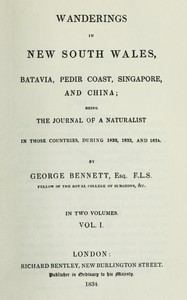
Wanderings in New South Wales, Batavia, Pedir Coast, Singapore, and China, Vol. 1 (of 2) — Context and Discussion can be approached with a clearer sense of reading commitment from its source measurements: 100,233 words, 7 hr 16 min estimated reading time, and 26 detected text sections.
The text analysis averages about 34.0 words per sentence, while the detected sections provide another way to judge how the source is divided.
Project Gutenberg metadata also associates the work with “New South Wales -- Description and travel,” connecting these edition facts with the source record’s subject description.
Explore this collection
These alternatives are selected using recorded categories and estimated reading time.
About 439 minutes
Geography
100,896 recorded words. 3 minutes difference from this book's estimate.
View Gutenberg source #72916About 432 minutes
Geography
99,194 recorded words. 4 minutes difference from this book's estimate.
View Gutenberg source #71651About 432 minutes
Geography
99,199 recorded words. 4 minutes difference from this book's estimate.
View Gutenberg source #77082Search stored excerpts and compare books → Choose by your preferences →
Choices use stored catalog measurements. Estimates vary with reading speed. A shared category is a catalog label, not a claim that two books have the same argument or literary quality.
Search reads excerpt text stored with this catalog and links to its associated Gutenberg record. The connection is stored in the site database; this tool does not recheck that every excerpt is word-for-word identical to that external record. Excerpt search does not cover every chapter and does not verify historical publication dates.
Catalog snapshot checked: 2026-09-25. Coverage: 97 public books, 97 available source excerpts.
Calculated from edition completeness, EPUB availability, text structure and catalogue metadata. Not a user rating.
Total of 100 points, scaled to a 2.5-5.0 range. Editions with an empty description or a missing EPUB file are not scored.
Public-domain source text
The source text is kept in the dedicated reader, separate from this catalogue record and its commentary.
George Bennett's journal moves through landscapes and seascapes with a naturalist's eye for detail, recording observations made "at the instant of observation" as he traveled from New South Wales to China between 1832 and 1834. The narrative shifts between dense botanical descriptions—noting the "Cumban" mallow and "Cundalong" nettle—and dramatic human episodes, such as the story of an Aboriginal woman who aided a convict paramour before being killed by her husband. This interplay between scientific cataloguing and colonial encounter shapes the work's structure.
The journal's structure is driven by geographic progression, but within each region Bennett alternates between close-up natural history and broader social observation. In New South Wales, a passage describing the "banks of the Murrumbidgee stream adorned with large swamp oaks" and listing native plant names gives way to a narrative of the convict and the Aboriginal woman. This juxtaposition is typical: Bennett moves from a specific plant or animal to a human story, then back to landscape. The transitions are often abrupt, reflecting the author's method of compiling notes without extensive revision. Readers should attend to these shifts, as they reveal how Bennett saw natural and human worlds as intertwined.
Water appears as a persistent motif, whether in the form of oceanic phosphorescence, rivers like the Murrumbidgee, or the severe drought mentioned in the Cape Verde Islands. Bennett describes the "luminosity of the ocean" and the "phosphoric light" of marine organisms with scientific curiosity, while on land he notes the "severe drought" that shapes vegetation and settlement. The contrast between abundant water and its absence recurs across different locales, from the "springs of water" in St. Jago to the "rich pasturage" of New South Wales. This imagery underscores the environmental conditions that Bennett, as a naturalist, considered fundamental to understanding each region.
Bennett's prose is marked by precise taxonomic observations, often including Indigenous names alongside Latin classifications. He identifies plants by their Aboriginal terms—"Plow'y," "Dad'ha," "Yarra"—and notes their uses or habitats. This dual naming system reflects his effort to record local knowledge while applying European scientific frameworks. His descriptions of animals, such as the Physalia or Portuguese man-of-war, include experiments and methods of preservation. The journal's authority derives from this accumulation of specific detail, though Bennett avoids "technicalities of science" for a general audience. The result is a text that balances amateur accessibility with professional rigor.
Interspersed with natural history are accounts of colonial society, including the treatment of convicts and Aboriginal people. The extended story of the convict and his Aboriginal protector is told with moral commentary, noting the "degradation" of women among "savage nations." Bennett also describes settler stations, such as "Cuney's Station" at Kitagarary Creek, and the practicalities of travel. These passages ground the naturalist's observations in the human geography of the colony. While Bennett does not explicitly critique colonialism, his narrative records its effects—violence, displacement, and cultural conflict—as part of the landscape he traverses.
Bennett's journal rewards readers who follow its digressions, from the taxonomy of a mallow to the fate of a convict. The work's value lies in its accumulation of specific, dated observations rather than in any overarching argument. Approaching it as a series of field notes—sometimes disjointed, always attentive—allows the reader to appreciate the naturalist's method and the world he recorded.
Reading Wanderings in New South Wales, I kept returning to George Bennett’s quiet patience with unfamiliar creatures, noting each quill and feather without rush. That same unhurried attentiveness surfaced later, almost unbidden, while leafing through El Toro — Edition Insights. There is something comforting in how both books hold still long enough for the details to breathe on their own.
Save your reaction, strongest insight, and memorable passage.