About 94 minutes
El Toro — Edition Insights
Geography
21,404 recorded words. 1 minutes difference from this book's estimate.
View Gutenberg source #76338
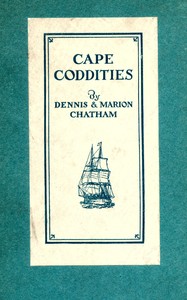
The source record for Cape Coddities — Edition Insights measures this digital text at 21,381 words, 1 hr 33 min estimated reading time, and 17 detected text sections.
The text analysis averages about 28.7 words per sentence, while the detected sections provide another way to judge how the source is divided.
Project Gutenberg metadata also associates the work with “Cape Cod (Mass.) -- Description and travel,” connecting these edition facts with the source record’s subject description.
Explore this collection
These alternatives are selected using recorded categories and estimated reading time.
About 94 minutes
Geography
21,404 recorded words. 1 minutes difference from this book's estimate.
View Gutenberg source #76338About 95 minutes
Geography
21,692 recorded words. 2 minutes difference from this book's estimate.
View Gutenberg source #65424About 109 minutes
Geography
24,910 recorded words. 16 minutes difference from this book's estimate.
View Gutenberg source #57618Search stored excerpts and compare books → Choose by your preferences →
Choices use stored catalog measurements. Estimates vary with reading speed. A shared category is a catalog label, not a claim that two books have the same argument or literary quality.
Search reads excerpt text stored with this catalog and links to its associated Gutenberg record. The connection is stored in the site database; this tool does not recheck that every excerpt is word-for-word identical to that external record. Excerpt search does not cover every chapter and does not verify historical publication dates.
Catalog snapshot checked: 2026-09-25. Coverage: 97 public books, 97 available source excerpts.
Calculated from edition completeness, EPUB availability, text structure and catalogue metadata. Not a user rating.
Total of 100 points, scaled to a 2.5-5.0 range. Editions with an empty description or a missing EPUB file are not scored.
Public-domain source text
The source text is kept in the dedicated reader, separate from this catalogue record and its commentary.
The essays in Cape Coddities move between saltwater and freshwater settings with a deliberate rhythm. The opening chapter, “A Message from the Past,” juxtaposes early explorers’ conflicting views of the Cape—Captain John Smith’s dismissive “shrubbie pines, hurts and such trash” against Gosnold’s ravishment at “the beautie and delicacie of this sweet soil.” This tension between harsh and idyllic recurs throughout the collection, often embodied in the physical landscape: porous sand that swallows rain, subterranean springs, and the sudden appearance of blue crabs in tidal pools.
The Cape’s geography is repeatedly described through a single image: “in the form of a sickle,” as Captain John Smith wrote in 1614. The authors return to this curved shape not as a mere fact but as a structural principle. The essays trace arcs from ocean beaches to inland ponds, from bustling summer colonies to isolated farms. In “A Fresh-Water Cape,” the porous soil is noted as a paradox: “a few minutes after a shower there is no trace of the rain,” yet underground channels feed 365 ponds in Plymouth County alone. This hidden water system mirrors the book’s own movement—what appears barren on the surface holds concealed abundance.
One of the most vivid set pieces describes crabbing as a “distinctly sporting event.” The narrative follows a precise sequence: spotting the crab, crawling to the bow, whispering directions, plunging the net. The crab’s shell transforms from “mud-colored” to “dark ultramarine blue” as it leaves the water, a metallic intensity that explains the chapter’s title, “A Blue Streak.” The authors emphasize patience and stealth—“as if the slightest noise would precipitate in flight this wily crustacean”—and note that even a college professor and former football players confess to the hunt’s fascination. The passage is typical of the book’s method: a small, local activity becomes a lens for observing character and place.
Two essays address the clash between old Cape Cod ways and the seasonal influx. “Motor Tyrannicus” (chapter V) treats the automobile as an invasive force, while “Change and Rest—Summer Bargaining” (chapter VI) examines the negotiation between locals and visitors. The authors do not take sides but record the friction with dry humor. The foreword warns that these are “thumbnail sketches” not to be taken as a serious attempt to “delineate its people,” yet the essays accumulate a portrait of a place defined by its dual identity: a working landscape and a playground. The recurring image of the sickle—curved, cutting, enclosing—suggests that the Cape itself shapes these encounters.
The final essays turn inward. “My Cape Farm” (chapter XII) and “Scallops” (chapter XIII) focus on subsistence and craft, while the “Aftermath” closes the collection with a reflective tone. The freshwater ponds, described as “never-ending wonder” in a porous land, become a metaphor for hidden depths. The authors note that at low tide, fresh water “oozes through the salty surface of sand and mud,” a geological detail that echoes the book’s own method: surface observations that yield unexpected interiority. The structure—from historical survey to intimate practice—mirrors the seasonal cycle of arrival, immersion, and departure.
Readers will find that Cape Coddities rewards attention to its recurring motifs: the sickle shape, the blue streak of a crab, the hidden fresh water. The essays are best approached as a sequence of linked observations rather than a comprehensive guide. Each chapter stands alone, but together they form a coherent portrait of a place where salt and fresh, past and present, constantly intermingle.
I keep returning to that chapter about the salt marsh at low tide, how the waterline seems to shift without moving. It reminded me of walking the ruined sanctuary at Olympia, where Pausanias’ measured descriptions leave the same quiet ache—the place itself holding what time has quietly removed. Pausanias' description of Greece, Volume II. — Context and Discussion felt like that: dry facts over wet memory, yet somehow more tender for it.
Answer a few questions and save a private reflection on this device.