About 94 minutes
El Toro — Edition Insights
Geography
21,404 recorded words. 1 minutes difference from this book's estimate.
View Gutenberg source #76338
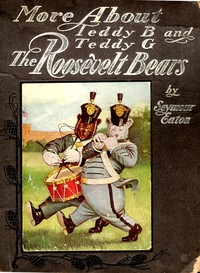
The source record for More About Teddy B. and Teddy G., the Roosevelt Bears Being Volume Two Depicting Their Further Travels and Adventures — A Reader’s Guide measures this digital text at 21,692 words, 1 hr 35 min estimated reading time, and 23 detected text sections.
The text analysis averages about 29.9 words per sentence, while the detected sections provide another way to judge how the source is divided.
Project Gutenberg metadata also associates the work with “Children's poetry,” connecting these edition facts with the source record’s subject description.
Explore this collection
These alternatives are selected using recorded categories and estimated reading time.
About 94 minutes
Geography
21,404 recorded words. 1 minutes difference from this book's estimate.
View Gutenberg source #76338About 93 minutes
Geography
21,381 recorded words. 2 minutes difference from this book's estimate.
View Gutenberg source #68998About 109 minutes
Geography
24,910 recorded words. 14 minutes difference from this book's estimate.
View Gutenberg source #57618Search stored excerpts and compare books → Choose by your preferences →
Choices use stored catalog measurements. Estimates vary with reading speed. A shared category is a catalog label, not a claim that two books have the same argument or literary quality.
Search reads excerpt text stored with this catalog and links to its associated Gutenberg record. The connection is stored in the site database; this tool does not recheck that every excerpt is word-for-word identical to that external record. Excerpt search does not cover every chapter and does not verify historical publication dates.
Catalog snapshot checked: 2026-09-25. Coverage: 97 public books, 97 available source excerpts.
Calculated from edition completeness, EPUB availability, text structure and catalogue metadata. Not a user rating.
Total of 100 points, scaled to a 2.5-5.0 range. Editions with an empty description or a missing EPUB file are not scored.
Public-domain source text
The source text is kept in the dedicated reader, separate from this catalogue record and its commentary.
The second volume of the Roosevelt Bears' travels continues the episodic, rhyming chronicle of Teddy B. and Teddy G. as they journey from Colorado to Washington, D.C. The book's structure is built around discrete adventures—each a self-contained episode—linked by the bears' relentless forward motion. Recurring images of noise, smoke, and explosive energy dominate the verse, as when the bears celebrate July Fourth with fireworks that send them "up and down in air" and leave their coat tails smoking. The text moves briskly from one scene to the next, often punctuated by sound effects like "Lickety-split-pat-pit-bang-boo!" that reinforce the sense of chaotic, joyful movement.
The book's narrative is organized as a series of loosely connected episodes, each introduced by a new heading—such as "The Roosevelt Bears visit the ZOO"—that signals a shift in setting. This structure mirrors the bears' journey as a tour of sights and experiences rather than a single plot. The verse maintains a consistent anapestic rhythm, propelling the reader forward with a galloping meter that suits the bears' restless energy. Transitions between episodes are abrupt, often relying on the bears simply deciding to move on: "Let's go to-morrow to the Zoo to see / The animals imprisoned there." This episodic approach allows the book to cover a wide range of locations and activities without requiring a complex overarching narrative.
Throughout the excerpts, noise and explosions are the dominant sensory images. The July Fourth episode is the most concentrated example: the bears and local boys string wires with crackers, fire rockets, and set off balloons, creating a scene of "slap and bang, in smoke and noise." The bears themselves are repeatedly singed—"They burned their paws and scorched their hair"—yet they treat the chaos as pure fun. This motif extends beyond the holiday: even a visit to the Liberty Bell involves the bears hoisting it "good and high," a physical feat that echoes the explosive, disruptive energy of their earlier antics. The sound effects embedded in the verse, such as "Lickety-split-pat-pit-bang-boo!" serve as auditory punctuation, reinforcing the book's emphasis on noise as a marker of excitement and freedom.
The bears' journey alternates between open landscapes—"their tramp across the land"—and enclosed, man-made spaces like the Zoo or the site of the Liberty Bell. This movement is often facilitated by climbing or breaching barriers: they climb fences, trees, and ladders, and in one instance they "struck the breakers with a splash" at the beach. The Zoo episode is particularly telling: the bears break in before dawn, carrying baskets of cake and treats, and Teddy G. declares he will "let out the Zoo" to free the animals. This pattern of entering restricted spaces and disrupting their order reinforces the bears' role as agents of playful anarchy. The transitions between scenes are marked by the bears' physical actions—climbing, jumping, or sailing—rather than by narrative reflection.
Teddy B. and Teddy G. consistently upend the expected order of things. In the July Fourth episode, they turn a quiet town into a battlefield of crackers and rockets, with the approval of the local boys. At the Zoo, they plan to break in and feed the animals cake, then free them. Even at the Liberty Bell, they physically hoist the historic object. The bears' dialogue reinforces this role: Teddy G. says, "I'll freedom teach / And try to practise what I preach." Their actions are framed as harmless mischief, but the text repeatedly emphasizes their disregard for rules and boundaries. This characterization is consistent with the author's stated aim in the preface: to teach children that animals have "human feeling" and are not merely targets for hunters. The bears' disruptive behavior becomes a vehicle for that lesson, presenting them as sympathetic rebels against a world that would confine them.
Readers approaching this sequel should expect a fast-moving, scene-by-scene journey rather than a continuous story. The verse rewards reading aloud, especially for the sound effects and rhythmic momentum. Pay attention to how the illustrations—described in the list of color plates—complement the text's emphasis on motion and noise. The bears' adventures are best enjoyed as a series of comic vignettes, each with its own setting and set of disruptions.
When Teddy B. and Teddy G. rumbled through those roaring American scenes, I found myself thinking of quieter journeys—the slow climb through Swiss mists in John L. Stoddard’s Lectures, Vol. 01 (of 10) Norway, Switzerland, Athens, Venice — A Closer Reading. Both books treasure the moment of arrival, the hush after smoke clears. Their kinship is that patient wonder, kept safe between covers. John L. Stoddard's Lectures, Vol. 01 (of 10) Norway, Switzerland, Athens, Venice — A Closer Reading waits like an old friend for whoever lingers.
Save your reaction, strongest insight, and memorable passage.