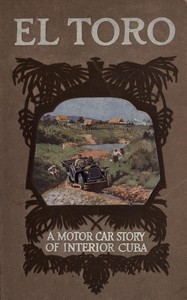
From the first page, El Toro establishes itself as a narrative of motion against resistance. The frontispiece caption—describing mountain passes so narrow that the car ran “with one wheel on a sloping side wall and the other on the crest of the deepest rut”—sets a pattern: every mile is earned by negotiating a specific, named difficulty. The book’s structure follows the journey’s own logic, moving from one obstacle to the next, with little pause for reflection. Recurring images—the car as a “big black beast, wallowing along in boundless marsh,” the landscape as a “white-paled arena”—give the prose a consistent visual vocabulary. The author rarely steps back to summarize; instead, the reader experiences each ford, each mudhole, each wrong turn as the party did, in sequence.
The Road as a Sequence of Obstacles
The narrative is built not around destinations but around the physical challenges of passage. The list of illustrations alone reads like a catalog of impediments: narrow passes, winding dirt roads, limestone stairways, ox-cart clearance, river fords, ruts that tear tires, and mud that swallows the car. Each chapter or section introduces a new terrain—rocky ravines, tall grass hiding swamps, a railway right-of-way used as a road, a plateau with no road at all. The author’s attention is always on the car’s interaction with the ground: “digging to obtain a footing for the wheels in the roughest ravines,” “shooting” through quagmires after probing their bottoms with a stick. This relentless focus on the immediate physical problem gives the book a tight, almost technical structure, as if the journey were a series of engineering tests.
Recurring Images: Beast, Arena, and the Sun as Guide
Three images recur with enough frequency to become motifs. First, the car is repeatedly likened to a living creature: a “big black beast, wallowing along in boundless marsh,” or, when stuck, sinking “helpless, into the mud as if, also, its day was done.” Second, the landscape is often described as an arena or enclosure: palm trunks “bank into a solid wall,” and the travelers find themselves “in the middle of a large, white-paled arena.” Third, the sun serves as a practical guide when roads vanish: “The sun is the best guide” and “guided by the sun and trying to keep to the correct general direction.” These images are not decorative; they reinforce the sense of a contest between machine and environment, with the sun as the only reliable reference point in a trackless interior.
Movement Between Scenes: From Rock to Mud to River
The journey’s rhythm is defined by abrupt transitions between radically different surfaces. The party moves from “the rocks that we had struggled over, back in Matanzas Province” into tall grass hiding swamps, then to a railway roadbed, then to a high plateau with “no road—only palm trees, by the thousands.” Later, they descend into a valley that “became muddier and muddier,” ford nine rivers in a single afternoon, and climb steep banks that “seemed to stand the car on end.” The author marks these shifts with simple transitional phrases—“After awhile we hit a sandy trail,” “We were in a valley”—but the effect is cumulative: the reader feels the constant change of terrain as a physical disorientation. The lack of any overarching map or plan heightens this sense of being moved through a landscape that resists easy passage.
The Role of Local Guides and Misinformation
Throughout the excerpts, the party relies on Cuban guides whose reliability varies sharply. A volunteer guide who “informed us that we were lost” turns out to have “invented his guide story to obtain a ride in the wonderful automobile.” The author notes that “Provincial Cubans do not travel far from home, ever, but they will wander in any direction with you and worry not at all about going back.” Later, a horseback rider who “appeared to be honestly familiar with the country” leads them back to the trail. These encounters are not developed into character studies; they are functional, showing how information—and misinformation—shapes the route. The book treats local knowledge as a resource as uncertain as the roads themselves, subject to the same unpredictability as the terrain.
Readers approaching El Toro should expect a lean, event-driven narrative that rarely pauses for description or reflection. The book’s value lies in its precise, almost documentary account of early motor travel in a difficult landscape. Pay attention to the verbs—shoot, wallow, ford, dig—and to the way each new obstacle forces a change in strategy. The journey is the story, and the story is the journey.
That rainy afternoon, El Toro — Edition Insights kept me fixed on mud and rock, the old car straining like a tired bull against Cuba's green walls. Afterwards, restless, I picked up Venice — Story, Setting & Ideas almost without thinking. Strange, how a place built on water felt like the same stubborn story — only the obstacle had changed. I forgot the rain entirely.