About 736 minutes
Pausanias' description of Greece, Volume I. — Themes and Context
Geography
169,056 recorded words. 6 minutes difference from this book's estimate.
View Gutenberg source #68946
Egypt of the Pharaohs and of the Khedivé — Reading Notes can be approached with a clearer sense of reading commitment from its source measurements: 167,720 words, 12 hr 10 min estimated reading time, and 69 detected text sections.
The text analysis averages about 23.4 words per sentence, while the detected sections provide another way to judge how the source is divided.
Project Gutenberg metadata also associates the work with “Egypt -- Description and travel,” connecting these edition facts with the source record’s subject description.
Explore this collection
These alternatives are selected using recorded categories and estimated reading time.
About 736 minutes
Geography
169,056 recorded words. 6 minutes difference from this book's estimate.
View Gutenberg source #68946About 697 minutes
Geography
160,297 recorded words. 33 minutes difference from this book's estimate.
View Gutenberg source #67401About 647 minutes
Geography
148,800 recorded words. 83 minutes difference from this book's estimate.
View Gutenberg source #70715Search stored excerpts and compare books → Choose by your preferences →
Choices use stored catalog measurements. Estimates vary with reading speed. A shared category is a catalog label, not a claim that two books have the same argument or literary quality.
Search reads excerpt text stored with this catalog and links to its associated Gutenberg record. The connection is stored in the site database; this tool does not recheck that every excerpt is word-for-word identical to that external record. Excerpt search does not cover every chapter and does not verify historical publication dates.
Catalog snapshot checked: 2026-09-25. Coverage: 97 public books, 97 available source excerpts.
Calculated from edition completeness, EPUB availability, text structure and catalogue metadata. Not a user rating.
Total of 100 points, scaled to a 2.5-5.0 range. Editions with an empty description or a missing EPUB file are not scored.
Public-domain source text
The source text is kept in the dedicated reader, separate from this catalogue record and its commentary.
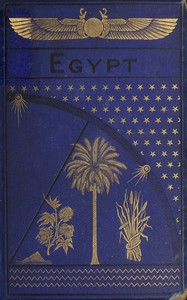
The author begins not with a journey but with an emblem: the winged, serpent-supported globe on the cover-plate. He offers a cautious interpretation—the sun as source of life, serpents as maternity, wings as protection—while acknowledging that such symbols “can be read only by the light of what is in the mind of the reader.” This measured, self-aware tone sets the pattern for a work that moves between ancient and modern Egypt with a voice that is erudite, occasionally wry, and always attentive to the physical remains of the past.
The narrator frequently steps back to qualify his own assertions. Discussing the cover-plate, he notes that “theological emblems, like theological terms, must vary in their import from time to time.” This habit of hedging—of admitting that other interpretations “might have been, and doubtless were, contained in the emblem”—gives the prose a careful, almost conversational rhythm. He does not claim certainty; instead, he builds arguments from observable details, such as the fact that the palm tree in his illustration was “cut from a photographic portrait” of a real tree in Wady Feiran. The effect is that of a learned companion who thinks aloud, weighing what can be known against what is lost.
The narrative pace changes markedly when the author turns to destruction. A long, methodical passage on how limestone and granite from ancient temples were reused—sent to kilns, turned into millstones, or carried off for building—builds a cumulative sense of loss. The sentences grow longer, piling up examples: Mehemet Ali’s nitre-works at Karnak, the calcining of sculptured stones in the pyramid district, the modern Arab following “the example of the old Egyptian.” Then, abruptly, the tone shifts to indignation: “Every one must wish that these imposing historic monuments… had been preserved.” But the author checks himself, noting that popes and cardinals did the same in Rome. This quick modulation—from forensic cataloguing to moral feeling to ironic detachment—is characteristic of the book’s restless intelligence.
Throughout the excerpts, the author uses contemporary observation to illuminate ancient practice. He notes that the Khedive’s public works have accelerated the destruction of tombs, and that “every one who revisits the country sees how rapidly and completely the stones of newly-opened tombs have disappeared.” This link between the 1870s and the Pharaonic era is not merely thematic; it structures the argument. The same forces—utility, neglect, economic pressure—that scattered the granite colossus of Rameses II are still at work. The author’s voice, at once scholarly and immediate, makes the reader feel that the past is not sealed off but continuously being unmade.
Readers should attend to the way Zincke moves between scales: from a single palm tree to the entire agricultural system of Egypt, from a broken propylon to the habits of centuries. His prose rewards those who follow its digressions, for the detours often contain the sharpest observations. The book is less a continuous narrative than a series of linked meditations, held together by a distinctive, sceptical curiosity.
I keep thinking about that old Egypt book, the way it mourned ruined temples while bustling past Cairo's coffee stalls. It felt like holding two eras at once. Something in Cairo to Kisumu — Background and Themes stirred that same ache for me, a quiet tracing of landscapes and lives slipping by. It lingers gently, not unlike a sunset you didn't mean to watch. Cairo to Kisumu — Background and Themes rests beside it now, softly. I found myself rereading small passages, just to stay in its weather a little longer.
Your answers remain private and are stored only in this browser.