About 730 minutes
Egypt of the Pharaohs and of the Khedivé — Reading Notes
Geography
167,720 recorded words. 6 minutes difference from this book's estimate.
View Gutenberg source #71987
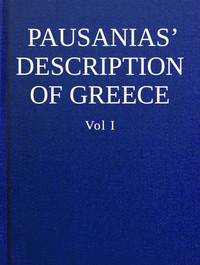
Pausanias' description of Greece, Volume I. — Themes and Context can be approached with a clearer sense of reading commitment from its source measurements: 169,056 words, 12 hr 16 min estimated reading time, and 207 detected text sections.
The text analysis averages about 20.9 words per sentence, while the detected sections provide another way to judge how the source is divided.
Project Gutenberg metadata also associates the work with “Greece -- Antiquities,” connecting these edition facts with the source record’s subject description.
Explore this collection
These alternatives are selected using recorded categories and estimated reading time.
About 730 minutes
Geography
167,720 recorded words. 6 minutes difference from this book's estimate.
View Gutenberg source #71987About 697 minutes
Geography
160,297 recorded words. 39 minutes difference from this book's estimate.
View Gutenberg source #67401About 818 minutes
Geography
188,089 recorded words. 82 minutes difference from this book's estimate.
View Gutenberg source #72128Search stored excerpts and compare books → Choose by your preferences →
Choices use stored catalog measurements. Estimates vary with reading speed. A shared category is a catalog label, not a claim that two books have the same argument or literary quality.
Search reads excerpt text stored with this catalog and links to its associated Gutenberg record. The connection is stored in the site database; this tool does not recheck that every excerpt is word-for-word identical to that external record. Excerpt search does not cover every chapter and does not verify historical publication dates.
Catalog snapshot checked: 2026-09-25. Coverage: 97 public books, 97 available source excerpts.
Calculated from edition completeness, EPUB availability, text structure and catalogue metadata. Not a user rating.
Total of 100 points, scaled to a 2.5-5.0 range. Editions with an empty description or a missing EPUB file are not scored.
Public-domain source text
The source text is kept in the dedicated reader, separate from this catalogue record and its commentary.
Pausanias' Description of Greece is neither a dry itinerary nor a pure mythography. The translator, A.R. Shilleto, renders a voice that moves fluidly from measured distances—'a hundred and fifty stades from Teuthrone'—to skeptical asides on divine geography. When discussing the Tænarum cave, Pausanias notes that 'there is no underground road leading up to the cave, nor could one easily believe that the gods have any underground dwelling,' yet he immediately entertains Hecatæus' rationalized serpent. This tension between autopsy and inherited story defines the work.
Pausanias often presents multiple accounts without forcing resolution. At Tænarum, he records that some Greeks claimed Hercules brought Cerberus from the underworld there, but he undercuts the tale: Homer 'gave him no name, nor complete description.' He then offers Hecatæus' version—a venomous serpent—as 'a probable legend.' The narrator does not dismiss the myth outright but shifts its register from supernatural to natural. Similarly, when describing the fountain at Tænarum that once showed harbors and ships, he reports the marvel flatly, then notes that a woman's washing 'stopped it for all time.' The cause is mundane, yet the tone remains neutral, as if cataloging a lost phenomenon.
Pausanias records cultic practices with an ethnographer's precision. At Thalamæ, he describes an oracle of Ino where petitioners 'get their oracular responses asleep, for whatever they want to know the goddess shews them in dreams.' He notes the materials of statues—brass for Pasiphae and the Sun—but admits that the temple's main statue is obscured 'from the quantity of the garlands.' This detail, both practical and evocative, suggests a living religion where offerings accumulate. He also traces genealogies of place-names: Œtylus was named after a hero 'from Argos, being the son of Amphianax.' Such passages ground the landscape in human lineage, not just divine myth.
The narrative alternates between swift topographical lists and extended digressions. A typical passage moves from 'About 40 stades' sail' to a chapel of Demeter, then a temple of Aphrodite 'near the sea,' then a stone statue—all in a single sentence. But when Pausanias reaches Tænarum, he pauses for a multi-paragraph excursus on Cerberus, Arion, and a grateful dolphin he claims to have seen at Poroselene. This shift in pace mirrors the traveler's own attention: routine geography yields to wonder. The dolphin anecdote, inserted without transition, feels like a personal aside—rare in a work otherwise anchored to third-person report. These changes in tempo give the text a conversational, almost associative quality.
Readers should attend to how Pausanias signals his own presence. He rarely says 'I saw,' but when he does—as with the dolphin—the work gains an unexpected intimacy. The translation by Shilleto preserves these shifts in register, from clipped distances to leisurely mythography. Approach the text not as a systematic guide but as a layered record of one traveler's encounters with a landscape dense with story.
Old Pausanias, you see, was a man who walked with legends at his heels, yet his sandals never left the dust. Decades later, I find that same wandering reverence in Tramping With a Poet in the Rockies — Reading Companion. Both are companions for the solitary path, where the solid rock underfoot keeps whispering certain verses. There is a quiet kinship in how they listen to the ground, and I hold them close on my shelf.
Answer a few questions and save a private reflection on this device.