About 730 minutes
Egypt of the Pharaohs and of the Khedivé — Reading Notes
Geography
167,720 recorded words. 33 minutes difference from this book's estimate.
View Gutenberg source #71987
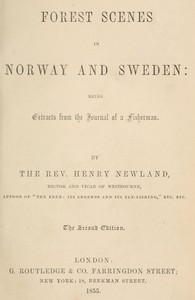
This digital edition of Forest Scenes in Norway and Sweden: Being Extracts from the Journal of a Fisherman — A Reader’s Guide is described by source-level measurements including 160,297 words, 11 hr 37 min estimated reading time, and 34 detected text sections.
The text analysis averages about 32.6 words per sentence, while the detected sections provide another way to judge how the source is divided.
Project Gutenberg metadata also associates the work with “Scandinavia -- Description and travel,” connecting these edition facts with the source record’s subject description.
Explore this collection
These alternatives are selected using recorded categories and estimated reading time.
About 730 minutes
Geography
167,720 recorded words. 33 minutes difference from this book's estimate.
View Gutenberg source #71987About 736 minutes
Geography
169,056 recorded words. 39 minutes difference from this book's estimate.
View Gutenberg source #68946About 647 minutes
Geography
148,800 recorded words. 50 minutes difference from this book's estimate.
View Gutenberg source #70715Search stored excerpts and compare books → Choose by your preferences →
Choices use stored catalog measurements. Estimates vary with reading speed. A shared category is a catalog label, not a claim that two books have the same argument or literary quality.
Search reads excerpt text stored with this catalog and links to its associated Gutenberg record. The connection is stored in the site database; this tool does not recheck that every excerpt is word-for-word identical to that external record. Excerpt search does not cover every chapter and does not verify historical publication dates.
Catalog snapshot checked: 2026-09-25. Coverage: 97 public books, 97 available source excerpts.
Calculated from edition completeness, EPUB availability, text structure and catalogue metadata. Not a user rating.
Total of 100 points, scaled to a 2.5-5.0 range. Editions with an empty description or a missing EPUB file are not scored.
Public-domain source text
The source text is kept in the dedicated reader, separate from this catalogue record and its commentary.
Henry Newland, a country rector, opens his journal with a playful dedication to “the Public,” defending his balance of work and play. The book is a second edition of extracts from his fisherman’s journal, covering travels in Norway and Sweden. Newland’s voice is that of a gentleman sportsman and observer, attentive to both the practicalities of eider duck hunting and the local legends he encounters, such as the tale of the alf frue and the leprous curse on the Gudmund family. His narrative moves between campfire conversations and precise descriptions of landscape, always aware of the tension between the parson at home and the parson abroad.
Newland presents himself as both a dedicated fisherman and a curious collector of local stories. In the excerpt, he recounts a legend about the Gudmund family, whose right hands are leprous because an ancestor broke a promise to an alf frue. The parson interprets this allegorically, linking it to the biblical “mammon of unrighteousness.” This moment reveals Newland’s method: he juxtaposes his own angling observations with the folklore he gathers from locals, treating both with seriousness. He also includes a footnote correcting a published account of eider duck shooting, insisting on his own experience over hearsay. This blend of personal authority and openness to local knowledge gives the journal a distinctive texture, somewhere between a sporting manual and a travelogue of cultural encounter.
The journal’s structure follows the practical rhythms of travel: preparations, the voyage, landfall, encampment, and departure. Chapter titles like “Making a Night of It” and “The Hell Fall” hint at both the physical challenges and the conviviality of the party. In the excerpt, the group concludes an eider duck hunt by packing up their cooking and dining apparatus, then rowing back to the steamer under a starry sky. The captain’s concern for delivering eider down to Marie and the parson’s tiredness anchor the scene in everyday logistics. Newland’s attention to such details—the stowing of paraphernalia, the snoring of the captain—grounds the narrative in the tangible world of travel, while the “three rippling lines of sparkling light” suggest a momentary poetic lift.
A key passage in the excerpt is a dialogue between the parson and the captain about the meaning of the alf frue legend. The captain asks whether the spirits of the mine can be saved, and the parson offers a theological reading. This exchange is interrupted by the captain’s practical concern about the steamer’s departure, a juxtaposition that Newland seems to relish. The conversation is not resolved; instead, it is cut short by the demands of the journey. This pattern—brief, unresolved discussions of folklore or morality embedded within the flow of travel—suggests that Newland values the texture of these encounters more than any definitive conclusion. The reader is left to weigh the parson’s allegorical interpretation against the captain’s matter-of-factness.
Newland’s journal rewards readers who enjoy the interplay of natural history, travel anecdote, and folk belief. The author’s voice is that of a thoughtful amateur, not a systematic scholar, and the book’s charm lies in its digressions and asides. Pay attention to the footnotes and the framing of local stories—they often reveal more about Newland’s own assumptions than about the places he visits. The journal is best read as a series of scenes rather than a continuous narrative, each chapter offering a fresh encounter with the Scandinavian landscape and its inhabitants.
That journal left me sitting quietly with its blend of river-light and old curses, especially the Gudmund family’s shadow. I found a similar stillness in Shavings & Scrapes from many parts — Reading Companion, where fragments of place and memory settle like wood shavings on a workbench. It doesn’t demand anything. It just lingers, the way those Norwegian evenings did.
Build a private reading journal entry for this title.