About 386 minutes
My American Diary — Text and Context
Geography
88,641 recorded words. 2 minutes difference from this book's estimate.
View Gutenberg source #59066
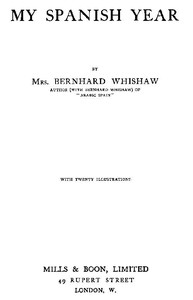
My Spanish Year — Text and Context can be approached with a clearer sense of reading commitment from its source measurements: 89,163 words, 6 hr 28 min estimated reading time, and 20 detected text sections.
The text analysis averages about 33.9 words per sentence, while the detected sections provide another way to judge how the source is divided.
Project Gutenberg metadata also associates the work with “Spain -- Description and travel,” connecting these edition facts with the source record’s subject description.
Explore this collection
These alternatives are selected using recorded categories and estimated reading time.
About 386 minutes
Geography
88,641 recorded words. 2 minutes difference from this book's estimate.
View Gutenberg source #59066About 406 minutes
Geography
93,155 recorded words. 18 minutes difference from this book's estimate.
View Gutenberg source #71363About 369 minutes
Geography
84,783 recorded words. 19 minutes difference from this book's estimate.
View Gutenberg source #71863Search stored excerpts and compare books → Choose by your preferences →
Choices use stored catalog measurements. Estimates vary with reading speed. A shared category is a catalog label, not a claim that two books have the same argument or literary quality.
Search reads excerpt text stored with this catalog and links to its associated Gutenberg record. The connection is stored in the site database; this tool does not recheck that every excerpt is word-for-word identical to that external record. Excerpt search does not cover every chapter and does not verify historical publication dates.
Catalog snapshot checked: 2026-09-25. Coverage: 97 public books, 97 available source excerpts.
Calculated from edition completeness, EPUB availability, text structure and catalogue metadata. Not a user rating.
Total of 100 points, scaled to a 2.5-5.0 range. Editions with an empty description or a missing EPUB file are not scored.
Public-domain source text
The source text is kept in the dedicated reader, separate from this catalogue record and its commentary.
Ellen M. Whishaw opens My Spanish Year with a playful proposition: the foreign visitor to Spain should treat its topsy-turvy inconveniences as comic opera. This framing device sets the tone for a narrative that oscillates between amused detachment and genuine cultural engagement. The author, writing as Mrs. Bernhard Whishaw, draws on her extended stay to offer observations that move beyond the typical tourist's complaints about tough beef or unpunctual trains. Instead, she invites readers to see Spain as a place that has resisted the homogenizing forces of modern travel, a last stronghold of romance in Western Europe. Her voice is conversational yet precise, capable of shifting from wry humor to detailed description of ritual and architecture.
Whishaw's introductory strategy is to frame Spanish daily life through the lens of comic opera, a deliberate choice that colors her entire narrative. She notes that many travelers expect Spain to be an enlarged edition of Bizet's Carmen, and she encourages them to smile when comic-operatic incidents unfold. This is not mere whimsy; it is a rhetorical tool that allows her to critique the impatience of tourists who exhaust themselves denouncing local failings. By contrast, she thanks her lucky stars that Spain remains much as God made it, rather than recast in the mould of tourist agencies. This opening establishes a voice that is both self-aware and gently ironic, preparing the reader for a travelogue that will balance humor with genuine appreciation.
One of the most vivid set pieces in the excerpts is the description of the Seises dance in Seville Cathedral. Whishaw details the elaborate ritual: the crimson velvet curtains, the silver reredos, the diamond-encrusted pyx. But her focus is on the young dancers themselves, the Seises, who practice for a year to master the complicated arabesques traced by small feet. She notes that there are over two hundred musical settings but only one rule for the dance, and that a choir boy must train for a full year before he can be promoted. The description is precise: white shoes and stockings, round hats turned up at one side with feathers, doublets of white satin with blue strips edged with gold. Whishaw observes that the costumes have degenerated from earlier grandeur, yet the Seises still strike a ringing note from the past as they hurry across the aisle. This passage demonstrates her ability to blend historical context with immediate sensory detail.
Whishaw's narrative voice shifts markedly when she turns to ecclesiastical history. In discussing the Mozarabic rite and its suppression in favor of the Roman, she adopts a more scholarly tone, tracing influences from Eastern ideas and the Yemenite Arabs who brought Coptic traditions in the eighth century. She connects these threads to the Abbadite court in Seville and the Fatimite Khalifs. This section is denser, less anecdotal, and reveals her research into Spanish religious art. The contrast with the earlier comic-opera framing is striking: Whishaw moves easily between the role of amused traveler and that of informed commentator. The excerpts do not reveal how she transitions between these modes, but the juxtaposition suggests a work that layers personal experience with historical inquiry, offering readers both entertainment and education.
Readers approaching My Spanish Year should be prepared for a narrative that shifts registers without warning. Whishaw's voice is the constant: wry, observant, and occasionally scholarly. The excerpts suggest that the book rewards those who enjoy both the absurdities of travel and the intricacies of local tradition. Pay attention to the moments when her tone changes—from the comic to the reverent, from the personal to the historical—as these shifts reveal the range of her engagement with Spain.
I keep returning to that afternoon with My Spanish Year—how Whishaw’s voice, half-amused and half-attentive, felt like sitting beside a friend who noticed everything. That same textured quietness surfaced later in Nigeria — Text and Context, though with different skies. Strange, how two distant places can echo the same careful way of seeing. I still wonder about that.
Capture what you thought, learned, and would like to remember.