About 388 minutes
My Spanish Year — Text and Context
Geography
89,163 recorded words. 2 minutes difference from this book's estimate.
View Gutenberg source #59293
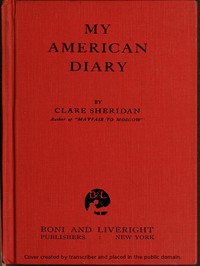
The catalog record for My American Diary — Text and Context provides practical reading context through 88,641 words, 6 hr 26 min estimated reading time, and 8 detected text sections.
The text analysis averages about 16.6 words per sentence, while the detected sections provide another way to judge how the source is divided.
Project Gutenberg metadata also associates the work with “Mexico -- Description and travel,” connecting these edition facts with the source record’s subject description.
Explore this collection
These alternatives are selected using recorded categories and estimated reading time.
About 388 minutes
Geography
89,163 recorded words. 2 minutes difference from this book's estimate.
View Gutenberg source #59293About 369 minutes
Geography
84,783 recorded words. 17 minutes difference from this book's estimate.
View Gutenberg source #71863About 406 minutes
Geography
93,155 recorded words. 20 minutes difference from this book's estimate.
View Gutenberg source #71363Search stored excerpts and compare books → Choose by your preferences →
Choices use stored catalog measurements. Estimates vary with reading speed. A shared category is a catalog label, not a claim that two books have the same argument or literary quality.
Search reads excerpt text stored with this catalog and links to its associated Gutenberg record. The connection is stored in the site database; this tool does not recheck that every excerpt is word-for-word identical to that external record. Excerpt search does not cover every chapter and does not verify historical publication dates.
Catalog snapshot checked: 2026-09-25. Coverage: 97 public books, 97 available source excerpts.
Calculated from edition completeness, EPUB availability, text structure and catalogue metadata. Not a user rating.
Total of 100 points, scaled to a 2.5-5.0 range. Editions with an empty description or a missing EPUB file are not scored.
Public-domain source text
The source text is kept in the dedicated reader, separate from this catalogue record and its commentary.
Clare Sheridan opens My American Diary with a deliberate nod to a predecessor: Lady Emmeline Stuart Wortley's 1850 travelogue. This framing device establishes Sheridan's self-awareness as a traveler and writer, acknowledging the tradition while signaling her own modern, less aristocratic perspective. The diary form itself shapes the narrative, offering immediate, unpolished impressions rather than a retrospective analysis. Sheridan's voice is direct and observant, often noting physical details—the 'broken wing' motion of Obregon's amputated arm, the 'hideous' Napoleon III furniture—that ground her encounters in tangible reality. The pace varies between leisurely descriptions of landscapes and tense, dialogue-driven scenes, such as the extended negotiation with the Mexican president over a portrait sitting.
Sheridan's introduction reveals a writer acutely aware of her role. She compares herself to Lady Emmeline, whose 'unconscious arrogance' and 'lack of humor' she both distances herself from and playfully invokes. This meta-commentary recurs throughout the diary: Sheridan frequently reflects on her own perceptions, noting when she is being 'determined not to be prejudiced' or when her impressions align with or diverge from expectations. The diary form allows her to capture fleeting thoughts and revise them later, creating a layered sense of self. For instance, her description of Chapultepec Castle as 'much prettier at night, lit up' contrasts with the 'deserted country house' feel during her visit, hinting at a gap between romantic expectation and mundane reality. This self-consciousness extends to her interactions: she presents herself as an 'historian' through portraiture, yet her persistence with Obregon reveals a blend of professional ambition and personal charm.
The centerpiece of the excerpt is Sheridan's audience with President Álvaro Obregón. The scene unfolds like a diplomatic chess match, with the interpreter acting as a 'deaf person through an ear trumpet.' Sheridan's account captures the tension and humor of the exchange. Obregon deflects her request for a sitting by citing modesty and fear of ridicule—'My people will think I am competing with the Venus of Milo!'—while Sheridan counters with a list of famous subjects who were not yet triumphant. The dialogue reveals both parties' rhetorical skill: Obregon's self-deprecation masks a firm refusal, while Sheridan's persistence is tempered by respect. The physical details—the 'one-armed General,' the 'stump' moving 'like a bird trying to use a broken wing'—add a layer of vulnerability to the political figure. The scene ends with a postponement of three years, a diplomatic stalemate that Sheridan records without editorializing, letting the reader sense the unresolved tension.
Sheridan's descriptions of Mexico blend awe with a traveler's practicality. She notes the 'endless labyrinth of real beauty' in a church's cloisters, the 'sun-bathed' patio with orange trees, and the 'background of mountain ranges' that frames every view. These passages slow the diary's pace, offering respite from the intensity of political encounters. Yet her eye remains selective: she remarks on the 'picturesque farmer' Don Trinidad, the 'largest fig tree I have ever seen,' and the dessert reachable by standing on a chair. Such details root the exotic in the everyday. The contrast between the ornate church interiors and the 'formal unlived-in' reception room at Chapultepec Castle underscores a theme of surfaces versus substance. Sheridan's travelogue is as much about the spaces she moves through as the people she meets, and her prose shifts fluidly between the panoramic and the intimate, mirroring the diary's own rhythm of observation and reflection.
Sheridan's diary resists easy categorization: it is part travelogue, part political commentary, and part personal record. Readers attentive to shifts in tone—from the conversational to the descriptive to the dramatic—will find a work that mirrors the unpredictability of travel itself. The incomplete nature of the excerpts leaves many questions unanswered, particularly about Sheridan's artistic practice and her longer stays. Yet the diary's strength lies in its immediacy, capturing a moment when an English sculptor navigated post-revolutionary Mexico and Jazz Age America with equal parts curiosity and composure.
That rainy afternoon, Clare Sheridan’s diary felt less like history and more like a hand on a windowpane—her restless, curious eye turning strangers into stories. I kept thinking of her wanderlust long after closing it, and somehow that led me to a quieter coastline. Cape Cod is a number of things — Themes and Context has that same unhurried noticing, though its tides move differently. One book simply opened the door to the other.
Use these questions to collect your thoughts before moving on.