About 495 minutes
Land and peoples of the Kasai — A Reader’s Guide
Geography
113,767 recorded words. 8 minutes difference from this book's estimate.
View Gutenberg source #76192
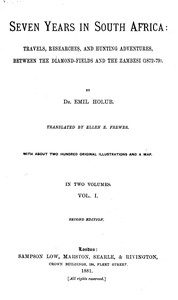
This digital edition of Seven years in South Africa, volume 1 (of 2) — Key Ideas to Explore is described by source-level measurements including 115,584 words, 8 hr 23 min estimated reading time, and 25 detected text sections.
The text analysis averages about 24.0 words per sentence, while the detected sections provide another way to judge how the source is divided.
Project Gutenberg metadata also associates the work with “South Africa -- Description and travel,” connecting these edition facts with the source record’s subject description.
Explore this collection
These alternatives are selected using recorded categories and estimated reading time.
About 495 minutes
Geography
113,767 recorded words. 8 minutes difference from this book's estimate.
View Gutenberg source #76192About 484 minutes
Geography
111,202 recorded words. 19 minutes difference from this book's estimate.
View Gutenberg source #72267About 482 minutes
Geography
110,768 recorded words. 21 minutes difference from this book's estimate.
View Gutenberg source #69270Search stored excerpts and compare books → Choose by your preferences →
Choices use stored catalog measurements. Estimates vary with reading speed. A shared category is a catalog label, not a claim that two books have the same argument or literary quality.
Search reads excerpt text stored with this catalog and links to its associated Gutenberg record. The connection is stored in the site database; this tool does not recheck that every excerpt is word-for-word identical to that external record. Excerpt search does not cover every chapter and does not verify historical publication dates.
Catalog snapshot checked: 2026-09-25. Coverage: 97 public books, 97 available source excerpts.
Calculated from edition completeness, EPUB availability, text structure and catalogue metadata. Not a user rating.
Total of 100 points, scaled to a 2.5-5.0 range. Editions with an empty description or a missing EPUB file are not scored.
Public-domain source text
The source text is kept in the dedicated reader, separate from this catalogue record and its commentary.
Emil Holub opens his preface by tracing his desire to explore Africa to boyhood reading of travel narratives. He explains that after seven years of work, he was urged by South African friends to publish, but only found time after arriving in London. The preface frames the book as a selection of leading incidents, with scientific observations deferred for later collaboration with specialists.
The first chapter begins with the voyage to the Cape, then describes Cape Town and Port Elizabeth. The tone is methodical, mixing geographical description with personal anecdote. A later excerpt from Chapter X shows Holub at Taung, where a crowd demands brandy—"Suppy, suppy, bas, verkup Brandwen!"—and he refuses despite offers of hides, milk, and a goat. The scene is rendered with precise detail: the tattered European clothes, the leather aprons, the swarm of naked children.
Holub’s preface is unusually direct about the book’s scope. He states that he made three journeys between the diamond fields and the Zambezi, but that the volume will only describe “the leading incidents in my travelling experiences.” Scientific observations, he says, would take three years to publish and would delay his return to Africa. This is not a comprehensive report but a selective narrative, shaped by the urgency of a planned second expedition.
The preface also reveals his audience: he hopes to increase public interest in South Africa, which he calls “the continent of the future.” The phrase is telling—it positions the book as a contribution to imperial knowledge and enthusiasm. Readers should note that Holub wrote after arriving home, not in the field, and that he had previously only sent “fragmentary articles” to South African newspapers. The book is a retrospective construction, not a diary.
The excerpt from Chapter X, set at Taung (also called Mahura’s Town), is one of the most vivid in the sample. Holub describes a ford on the Kuruman River, where a crowd of men, women, and children surrounds his wagon demanding brandy. The men wear “tattered European clothes” or “a mangy skin”; the women are “naked except for little leather aprons”; the children are “as naked as when they were born.” They offer jackal hides, goat-skins, bullock-thongs, a yoke, wooden spoons, and even a couple of greasy shillings. Holub refuses all, and the crowd becomes so insistent that he must “almost beat them off.”
The scene is striking for its asymmetry of power and desire. The locals want alcohol; Holub wants to pass. He describes the encounter as “disgusting,” but his own position is not neutral—he is the one who withholds, who drives on, who is “inexorable.” The passage also includes a brief portrait of a white smith living by the ford, who complains that the population’s impoverishment has hurt his business, while his rival spent all his earnings on brandy. The ford itself is dangerous: “nearly every third waggon managed more or less to come to grief.”
The table of contents shows that the book proceeds geographically: from Cape Town to Port Elizabeth, then to the diamond fields, and onward. The excerpt from Chapter X is roughly a third of the way through the volume (page 236 of 115,584 words). The narrative moves at the pace of a wagon—slow, interrupted by fords, weather, and encounters. Holub often pauses for description: the “yellow water” of the river, the “rocky island” in the middle, the acacia tree under which the smith’s wagon stands.
These pauses are not digressions; they are the substance of the travelogue. Holub is as interested in the smith’s complaint about business as in the ford’s geology. The book’s rhythm alternates between movement and stasis, between the open veld and the crowded village. Readers should expect a narrative that lingers on practical details—how to cross a river, how to negotiate with a chief—rather than on dramatic events.
The translation is by Ellen E. Frewer, who also translated other travel narratives of the period. Her English is fluent and slightly formal, with a preference for compound sentences and periodic structure. For example: “As we wended our way down the slope, we came within view of another native village.” The voice is consistent, but readers should be aware that this is a mediated text—Holub’s original German has been smoothed into Victorian English prose.
The book includes “about two hundred original illustrations and a map,” though these are not reproduced in the Project Gutenberg text. The illustrations are mentioned in the front matter as part of the original edition. The map, in particular, would have been essential for following Holub’s routes. Without it, the reader must rely on place names—Taung, Kuruman, the Zambesi—to orient themselves. The text itself provides some geographical context, but not systematically.
Holub’s narrative is best approached as a sequence of scenes rather than a continuous story. The preface warns that scientific details are omitted, so the reader should not expect systematic ethnography or natural history. Instead, the book offers a traveller’s perspective: episodic, opinionated, and grounded in the material realities of wagon travel. Pay attention to the small observations—the condition of a ford, the price of a bottle, the state of a man’s coat—because they carry the weight of the larger encounter between European ambition and African landscapes.
Reading Holub’s refusal at Taung, I remembered sitting in my grandfather’s study, tracing his old atlas’s faded routes. That same quiet unease—how presence changes a place—came back with What I Saw in Berlin and Other European Capitals During Wartime — A Closer Reading. Different maps, same ache: the traveler’s solitude, the stubborn weight of another’s customs pressing against your own.
Save your reaction, strongest insight, and memorable passage.