About 122 minutes
Grand moving diorama of Hindostan — A Reader’s Guide
Geography
28,000 recorded words. 3 minutes difference from this book's estimate.
View Gutenberg source #60006
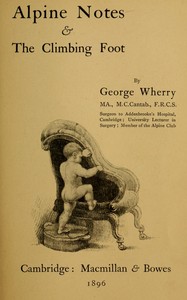
For Alpine notes and the climbing foot — Edition Insights, the stored edition analysis reports 28,728 words, 2 hr 5 min estimated reading time, and 14 detected text sections.
The text analysis averages about 22.2 words per sentence, while the detected sections provide another way to judge how the source is divided.
Project Gutenberg metadata also associates the work with “Mountaineering,” connecting these edition facts with the source record’s subject description.
Explore this collection
These alternatives are selected using recorded categories and estimated reading time.
About 122 minutes
Geography
28,000 recorded words. 3 minutes difference from this book's estimate.
View Gutenberg source #60006About 122 minutes
Geography
28,053 recorded words. 3 minutes difference from this book's estimate.
View Gutenberg source #74413About 116 minutes
Geography
26,630 recorded words. 9 minutes difference from this book's estimate.
View Gutenberg source #57437Search stored excerpts and compare books → Choose by your preferences →
Choices use stored catalog measurements. Estimates vary with reading speed. A shared category is a catalog label, not a claim that two books have the same argument or literary quality.
Search reads excerpt text stored with this catalog and links to its associated Gutenberg record. The connection is stored in the site database; this tool does not recheck that every excerpt is word-for-word identical to that external record. Excerpt search does not cover every chapter and does not verify historical publication dates.
Catalog snapshot checked: 2026-09-25. Coverage: 97 public books, 97 available source excerpts.
Calculated from edition completeness, EPUB availability, text structure and catalogue metadata. Not a user rating.
Total of 100 points, scaled to a 2.5-5.0 range. Editions with an empty description or a missing EPUB file are not scored.
Public-domain source text
The source text is kept in the dedicated reader, separate from this catalogue record and its commentary.
George Wherry, a Cambridge surgeon and Alpine Club member, assembled these notes from letters originally published in the Cambridge Chronicle over five seasons. The preface admits they were “mostly written with pencil in the railway train” returning from holidays, and he kept revisions minimal. The result is a hybrid: part personal travel diary, part technical manual on foot mechanics and climbing safety. The opening excerpts already reveal this dual focus—Wherry describes the Great St. Bernard Hospice with its dogs and monks, then shifts to the “climbing foot” with photographs of an infant’s grip. Readers should expect abrupt transitions between anecdote and anatomy, as the author himself warns that some passages “savour of another craft, more useful even than mountaineering.”
Wherry’s medical training surfaces in unexpected places. When he notes that “the remarkable adaptation of the tiny infant’s foot for climbing and all-four progression is very well shown” in the photographs, he is not merely praising the photographer but grounding his observations in functional anatomy. Later, crossing the St. Theodule Pass, he remarks on the “hot and fatiguing walk through fresh snow” and the need for “dark glasses” against the glare—small details that a less observant writer might omit. His description of the St. Bernard dogs includes a skeptical aside: “Alas! to give up the cherished delusion that the dogs search for lost travellers in the snow!” He then quotes an older account of dogs guiding caravans, showing his willingness to correct popular myths with on-site experience.
The “climbing foot” chapter, though not fully excerpted here, is clearly central to Wherry’s project. He includes photographs by Captain Abney of Swiss guides and by Mr. Stearn of an infant’s foot held in position “with my finger.” The preface frames these as practical aids: “similar notes, put into my hands when I began climbing, would have been read by me with avidity.” Wherry’s approach is that of a teacher who believes in precise, visual instruction. Even in the travel letters, he notes the condition of his guides—one “seemed rather out of condition” and brought along a nephew—and the logistics of roping “as in duty bound over the névé.” These asides accumulate into a quiet argument that successful mountaineering depends on physical readiness and disciplined technique, not just enthusiasm.
Wherry’s interactions with local guides and officials reveal the social texture of Alpine travel in the 1890s. At St. Rémy, the muleteer “was anxious to know whether I had tobacco or cigars, and carefully hid his own modest packet before he led us to the Custom House.” The Italian guide on the St. Theodule route “begged to be allowed to bring along a boy, his nephew, who was to be no further expense to monsieur”—a negotiation that ends with the boy coming along anyway, “obtain[ing] a vast amount of pleasure at a small cost to his employer.” These vignettes are lightly comic but also practical: they show how a climber must manage relationships, currency, and local customs. Wherry presents himself as a seasoned traveler who knows when to yield and when to insist, a skill as important as footwork on ice.
Wherry weaves literary references into his route descriptions. He quotes Meredith’s The Amazing Marriage at length in the preface, where a character says, “Up in those mountains one walks with the divinities.” The quote serves as an epigraph for the whole collection, linking physical exertion to spiritual elevation. On the Great St. Bernard, he invokes Napoleon’s crossing and notes that “we lunch in the same room at Bourg St. Pierre.” These allusions are not mere decoration; they place Wherry’s own journey within a tradition of Alpine writing that includes military history and fiction. The reader is invited to see the landscape as layered with earlier stories, from Hannibal to the present day. Wherry’s own prose, however, remains grounded in the immediate: the “blue Italian sky” after the pass, the “cretins” in the Aosta valley, the “very fine view of the Matterhorn” at the end of a climb.
Wherry’s notes reward a reader who can tolerate digression and appreciate a writer more interested in accuracy than in literary polish. The letters were never meant to be a continuous narrative; they are dispatches from a working mountaineer who also happened to be a surgeon. Approach them as a series of field observations, and you will find unexpected insights into both the Alps and the craft of climbing at the turn of the century.
Wherry’s long train journeys home, scribbling about the Matterhorn’s spurs, reminded me of my own return from Norway, when the fjords dissolved into rain. His surgeon’s eye, our fisherman’s patience—both are ways of keeping a place close. I still feel that stillness when I recall Forest Scenes in Norway and Sweden: Being Extracts from the Journal of a Fisherman — A Reader’s Guide; it held the same quiet ache of remembering.
Answer a few questions and save a private reflection on this device.